
Picture books that explore gender stereotypes –
We have done our best to include stories that feature boys and girls enjoying activities that might be traditionally be labelled “feminine” or “masculine.”
As well, you will find picture books that can be used to provoke discussion about stereotypes and acceptance and others that specifically address gender identity and gender dysphoria.
We want to share valuable resources for children, families, teachers and librarians. If you would like to suggest additional picture books, please email or leave a comment. Thank you.
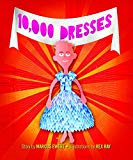
10,000 Dresses written by Marcus Ewert and illustrated by Rex Ray
Picture book that explores gender identity and stereotypes published by Triangle Square
When Bailey dreams, her thoughts turn to dresses and how wonderful it would be to try each one of them on. She imagines one dress made of crystals and another made of lilies, roses and honeysuckles. When Bailey tells her mom, dad and brother of her dreams and her wish to have dresses like the ones in her dreams, they each dismiss her and remind her that she is a boy and boys don’t wear dresses!
Fortunately, Bailey runs away from her house and her family’s closed minds. At the end of her block, she meets an older girl who wants to create dresses but lacks creative inspiration. Together, Bailey and Laurel design dresses that, “show us OURSELVES.
10,000 Dresses is on the 2009 American Library Association Rainbow Book List and was found to be “exceptional and highly recommended.”
10,000 Dresses at Amazon.com
10,000 Dresses at Amazon.ca
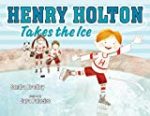 Henry Holton Takes the Ice written by Sandra Bradley and illustrated by Sara Palacios
Children’s book about individuality and following one’s dream published by Dial Books for Young Readers
Henry’s family LOVES hockey! His sister plays, his parents play, his cousins play and everyone assumes that Henry will play hockey too. Henry does learn to skate but his unconventional style is not quite right for the sport. Holding a stick doesn’t feel good. Henry prefers to twist, turn and sway on the ice rather than bodycheck an opponent.
When Henry gets a chance to see a local ice dancing club at the arena, he decides that is where he belongs. Henry’s grandmother is the first family member to accept his choice but others soon follow and celebrate his goal of becoming an ice dancer.
As someone who has spent quite a lot of time in hockey rinks, I found it surprising to see Henry on the ice without hockey gloves and a helmet. It is disappointing to think that Henry had to “bench himself” for weeks in order to be heard. A solid reminder that respect for individuality and personal preferences is paramount – even with young children.
A Glossary of Hockey Terms is included.
A somewhat predictable storyline, Henry Holton Takes the Ice is best-suited to children aged 5 and up.
Henry Holton Takes the Ice at Amazon.com
Henry Holton Takes the Ice at Amazon.ca
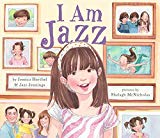
I Am Jazz written by Jessica Herthel and Jazz Jennings with pictures by Shelagh McNicholas
Biographical picture book about a child with Gender Dysphoria published by Dial Books for Young Readers
For long as Jazz can remember, she has loved pink and dancing and makeup and mermaids. She likes to pretend that she is a “pop star.” She has friends who are girls and they love to do things together but Jazz knows that she has “a girl brain but a boy body. This is called transgender.”
Her family thought of Jazz as a boy but she insisted that was not right. Eventually, Jazz and her parents go to a doctor and the doctor explains that Jazz is transgender.
With coaching, Jazz’s teachers and coaches ensure that Jazz is treated like other girls. Jazz acknowledges that some classmates tease her but she takes comfort in the friendships she shares and she embraces being different.
I Am Jazz is on the 2015 American Library Association Rainbow Book List.
I Am Jazz at Amazon.com
I Am Jazz at Amazon.ca
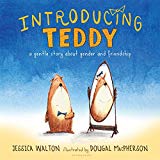
Introducing Teddy written by Jessica Walton and illustrated by Dougal MacPherson
Picture book about friendship and gender fluidity published by Bloomsbury
Thomas the Teddy and Errol spend time together every day. Errol pulls Thomas in his wagon, Errol and Thomas plant seeds together and they sit together in a treehouse.
One day, Errol notices that Thomas seems withdrawn.
Thomas has something he needs to say but he worries that he might upset Errol. He feels that he could lose his friend if he is truthful. Errol assures Thomas that their friendship will withstand the news, whatever it is.
“Thomas the Teddy took a deep breath. “I need to be myself, Errol. In my heart, I have always known that I’m a girl teddy, not a boy teddy.”
Errol reassures Tilly that she will always be a friend and the two of them get back to fun and games with a third friend. Ava likes building robots and rides a scooter.
A lovely story that is suitable for very young children, unlike some of the other picture books we write about, Introducing Teddy does not have characters who tease or berate the character for transitioning from male to female.
Introducing Teddy is on the 2017 American Library Association Rainbow List
Introducing Teddy at Amazon.com
Introducing Teddy at Amazon.ca
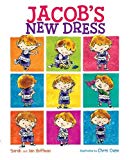
Jacob’s New Dress written by Sarah and Ian Hoffman and illustrated by Chris Case
Picture book about gender nonconformity published Albert Whitman and Company
Jacob loves the dress-up corner at preschool and can’t wait to wear the pretty pink dress when he plays with his friends. A classmate does not approve of Jacob’s choice and suggests that Jacob choose something more masculine.
“The dress-up corner is where we come to use our imaginations,” Ms. Wilson said. “You can be a dinosaur, a princess, a farmer — anything!”
After school, Jacob talks with his mother and she reassures him that boys can, indeed, wear dresses. Jacob tries on a favorite Halloween costume but wants a less special dress to wear to school.
The following day, Jacob appears in a dress-like outfit he has made himself, using a bath towel. It does not make it through the school day so Jacob and his mom set about sewing a dress together.
Bright, bold illustrations effectively depict Jacob’s emotions and especially exhuberant excitement when able to express himself freely. A lovely picture book to share at home or in a classroom setting.
Jacob’s New Dress at Amazon.com
Jacob’s New Dress at Amazon.ca
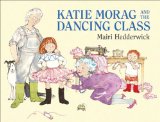 Katie Morag and the Dancing Class written and illustrated by Mairi Hedderwick
Picture book about individuality published by Transworld Publishers
Katie Morag & the Dancing Class  is a delightful picture book from Mairi Hedderwick. Set in Scotland, it has been decided that the Isle of Struay children will benefit from dancing classes. Despite the efforts of her two grandmas, Katie Morag has more interesting things to do than learn ballet. Much to Granma Mainland’s dismay, Katie prefers wellies to ballet slippers and never manages to arrive at her ballet class on time.
One Saturday morning, Katie misses the entire class, arriving just as The Big Boy Cousins begin their tap dance class. As those who know Katie might suspect, she is more inclined toward tap dancing than ballet and before long Grannie Island is rummaging in her cupboards for metal tacks.
Katie Morag has long been a favorite in our household. We first met her in Katie Morag Delivers the Mail and have enjoyed her many adventures and misadventures very much. There is a gentleness to the stories and a wonderful sense of community. In this book, the contrast between the two grandmas (Granma Mainland and Grannie Island) is highlighted. Of course, both want what is best for Katie but it is Grannie Island who understands her best.
Katie Morag and the Dancing Class at Amazon.com
Katie Morag and the Dancing Class at Amazon.ca
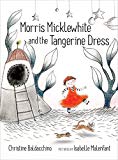 Morris Micklewhite and the Tangerine Dress written by Christine Baldacchino and illustrated by Isabelle Malenfant
Picture book that examines gender stereotypes published by Groundwood Books
Probably my favorite picture book on this list, Morris Micklewhite and the Tangerine Dress is beautifully illustrated and uses onomatopoeia to describe the sounds Morris hears when he chooses to wear a tangerine dress from the dress-up center at school.
He likes the noises the dress makes-
swish, swish, swish when he walks and crinkle, crinkle, crinkle when he sits down.
He takes turns wearing all the different shoes, but his most favorite ones go click, click, click across the floor.
Morris hears the taunts of his classmates and he would like to join in their activities but he remains true to himself and, eventually wins them over.
Beautifully written and illustrated, Morris Micklewhite and the Tangerine Dress shares an important message about acceptance that should be shared widely.
Morris Micklewhite and the Tangerine Dress is on the 2015 American Library Association Rainbow Book List.
Morris Micklewhite and the Tangerine Dress at Amazon.com
Morris Micklewhite and the Tangerine Dress at Amazon.ca
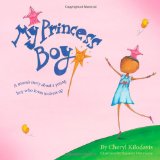
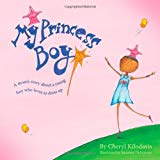 My Princess Boy written by Cheryl Kilodavis and illustrated by Suzanne De Simone
Picture book about gender identity, social acceptance and unconditional love published by Simon and Schuster
What happens if a young boy loves to dress up in pink and sparkles? In a dress and a tiara? In a pretty ballet costume? In this boy’s family, his preferences are celebrated and respected. Mom, Dad and his older brother are all accustomed to having him choose to wear jewellery and to wear clothing that most will think of as feminine. Outside of home and close friendships, the world may not be as accepting for example, he has been stared at when shopping and trick-or-treating.
Young readers are encouraged to think about what might happen at school and how they might react if a classmate or friend wanted to make unconventional choices.
My Princess Boy has faced some criticism because all of the faces lack features and, although we are told that he likes pretty things,” the main character does not smile, nor do his family or friends.
The concept of acceptance and unconditional love is an excellent one but I do wonder if having the central character older than four years might have been a better choice. I can well-imagine four-year-olds being puzzled by why a Halloween costume is an issue. The Dress-Up Centre at my sons’ preschool was not particularly focused on gender stereotypes and Halloween costumes for four-year-olds are pretty much “anything goes.”
My Princess Boy website
My Princess Boy at Amazon.com
My Princess Boy at Amazon.ca
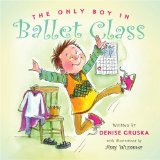
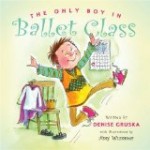 The Only Boy in Ballet Class – written by Denise Gruska and illustrated by Amy Wummer
Picture book that explores stereotypes published by Gibbs Smith
Tucker loves to dance and especially likes ballet.
“It feels right to him. Like breathing.”
His unconventional passion for dance means that his classmates view him as weird and he is generally the last person chosen for team sports. Rather than joining other boys for football practice, he rushes to a dance class. Enroute, he endures teasing but, once he arrives at the studio, his heart swells and he feels pride in accomplishment.
At home, Tucker’s mom is very supportive of his involvement in ballet, “I don’t like that you love to dance. I love that you love to dance!”
A visiting uncle is not nearly as compassionate. He thinks Tucker ought to play football.
An afternoon ballet recital is a perfect opportunity to demonstrate his love of ballet, as Tucker takes on the role of a prince during a performance. Tucker’s mom and sisters are delighted with the show. Unconvinced, Uncle Frank remains committed to the merits of more ‘manly’ sports.
While walking home from the recital with his family, a member of the neighborhood football team spots Tucker and asks, “Hey, Twinkle Toes, wanna play football?” With Uncle Frank at his side, Tucker is hard-pressed to say, ‘no.’ Before long he is wearing a football jersey and helmet and suddenly finds himself involved in an important play during a championship game.
“In the point of a toe, he was on the shoulders of every boy who had ever made fun of him, and they were carrying him across the field chanting, “Tuck-er! Tuck-er! Tuck-er” Even Uncle Frank was dancing.” A “magical” solution to being accepted is perhaps not quite as strong a statement as we may have hoped for, ballet remains Tucker’s joy and he is shocked but pleased when a group of football players decides to join his ballet class.
The Only Boy in Ballet Class website
Best suited for children aged five and up.
The Only Boy in Ballet Class at Amazon.com
The Only Boy in Ballet Class at Amazon.ca
 Red: A Crayon’s Story written and illustrated by Michael Hall
Metaphorical Picture Book published by Greenwillow Books
Wrapped in crimson paper and labelled, “Red,” something just isn’t right. When Red mixes with Yellow, instead of creating something orange, they produce a big green mess. Red’s family members have opinions and the other art supplies want to help but adding masking tape, snipping his label and sharpening his tip don’t change a thing.
It is only when Red meets Berry that he is encouraged to express his blueness. It is not long until his true color and qualities are celebrated by family and friends.
An excellent resource for provoking discussion about labels and how categorizing a child (or adult) as shy, learning disabled, athletic, musical, gifted, hyperactive, masculine or feminine can limit their potential and disrespect their unique qualities, preferences and attributes.
Red: A Crayon’s Story is a metaphorical story that, with guidance will prompt reflection and critical thinking about labels by (older) children and adults.
Red: A Crayon’s Story is on the 2016 American Library Association Rainbow Book List
Red: A Crayon’s Story at Amazon.com
Red: A Crayon’s Story at Amazon.ca
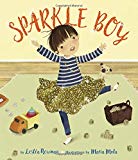 Sparkle Boy written by Leslea Newman and illustrated by Maria Mola
Picture book about a boy who likes things that sparkle published by Lee and Low Books Inc.
Casey knows exactly what he likes and he is sufficiently confident to ask for it. He watches and admires his sister, Jessie when she wears a shimmery skirt. Casey wants to wear a skirt too and his mama hesitates at first but soon gives him one to wear. Next, Casey is drawn to his sister’s beautiful nail polish. Before too long, his father is painting his son’s finger nails. Finally Casey’s grandmother comes for a visit and she gives one of her bracelets to Jessie to wear. Casey wants one too and Grandma gives him one.
Sparkle Boy beautifully depicts the unconditional and non-judgemental love of a Casey’s parents and grandmother. Casey’s sister, Jesse is not quite ready to accept her brother’s personal choices until he is publicly ridiculed. Then, Jesse’s love and acceptance is beautifully portrayed.
A glowing picture book that encourages self-expression and embraces respect for all.
Sparkle Boy at Amazon.com
Sparkle Boy at Amazon.ca
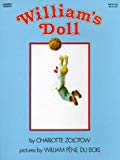 William’s Doll written by Charlotte Zolotow and illustrated by William Pène Du Bois
Classic picture book that challenges gender stereotypes published by Harper & Row
Although William’s Doll has faced some criticism due to illustrations that appear “dated,” the message in Ms. Zolotow’s story remains timely. When William explains that he would like to have a doll to cherish, his dad, his older brother and his brother’s friend each respond negatively. His father gives him traditionally “masculine” toys, including a train set and a basketball. William’s brother thinks playing with a doll is “creepy” and his brother’s friend calls him a “sissy.”
When William’s grandmother comes to visit, he shows her that he can play basketball well and he can play with trains but neither will replace the doll that he hopes for. William’s grandmother understands how important this is to him and buys him one at a store. Her unconditional love and acceptance is exactly what William needs.
A lovely message to share with young children, my only concern is that William will still have to deal with older children who name-call and a father who is determined to have his son play with “boy” toys. These would both be important issues to explore after reading this thought-provoking classic picture book.
William’s Doll at Amazon.com
William’s Doll at Amazon.ca
Resources
12 Things Every Gender Nonconforming Child Wants You to Know by Kira Walton and published on Read it Forward
American Psychology Association – Society for the Psychology of Sexual Orientation and Gender Diversity
Gender Diverse and Trans-Gender Children from the American Academy of Pediatrics
























 Goodnight Moon written by Margaret Wise Brown and illustrated by Clement Hurd
 , children will make connections between the two books especially when they look carefully at the illustrations.

 The Very Hungry Caterpillar by Eric Carle

 Brown Bear, Brown Bear What Do you See? by Bill Martin Jr and Eric Carle

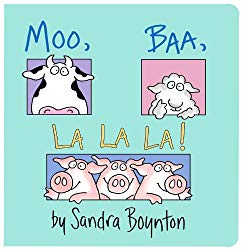 Moo, Baa, La La La! by

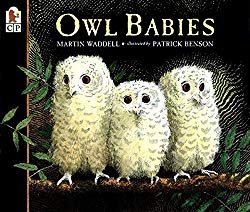 Owl Babies written by Martin Waddell and illustrated by Patrick Benson

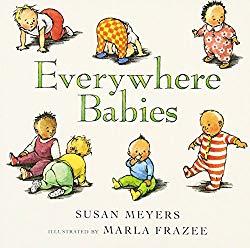 Everywhere Babies written by

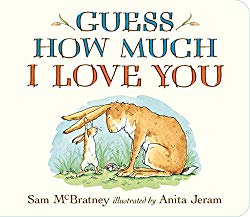 Guess How Much I Love You by Sam McBratney and illustrated by

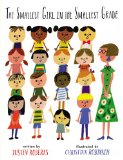
 and another called
  . The album titles alone are enough to bring a smile to a weary parent’s face. So, I wanted to think that
  was terrific.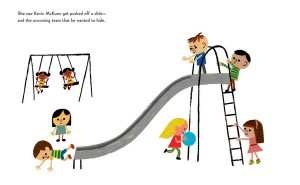

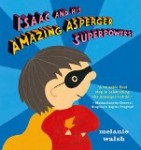
 is a cheerful, positive and reassuring picture book that explains how Isaac’s thoughts and behavior sometimes differ from those of his friends. Well-suited to preschool-age children or early primary classroom use, bright, bold illustrations are visually appealing and will be easily seen and interpreted in a group or classroom setting.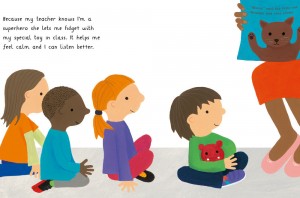






%20%20and%20another%20that%20will%20be%20enjoyed%20by%20independent%20readers%20(Happy%2C%20Happy%20Chinese%20New%20Year!).)



%20%20and%20another%20that%20will%20be%20enjoyed%20by%20independent%20readers%20(Happy%2C%20Happy%20Chinese%20New%20Year!).)









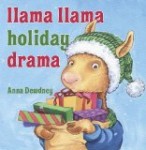 Llama Llama Holiday Drama written and illustrated by




































 is a book that can be enjoyed on many levels. Best suited to children five and up.