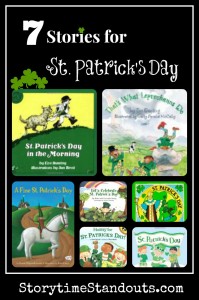

For each petal on the shamrock this brings a wish your way –
Good health, good luck, and happiness for today and every day.
~Author Unknown
Link to our free St. Patrick’s Day Free Printables for Children ~

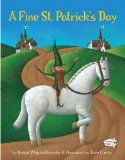 A Fine St. Patrick’s Day written by Susan Wojciechowski and illustrated by Tom Curry
St. Patrick’s Day fable published by Dragonfly Books,Random House Kids
Each St. Patrick’s Day, rival towns, Trala and Tralee compete, and year after year Tralah wins the competition and is declared “Best Decorated.” When one young resident of Tralee proposes a way to win the upcoming event, her suggestion is embraced by the residents of the town. Everyone gets involved in the project until a small man arrives in the town and asks for help.
He crossed the field into Tralee. At the first house he came upon, he asked, “Beggin your pardon, can you help me? I was leading my cows across the river and, sure and begorra, they are stuck in the mud.”
Folk art style illustrations beautifully enhance a terrific story that explores themes of social responsibility, community and kindness. A Fine St. Patrick’s Day is highly recommended for children aged four years and up.
A Fine St. Patrick’s Day at Amazon.com
A Fine St. Patrick’s Day at Amazon.ca
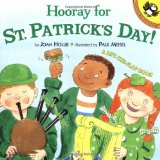 Hooray for St. Patrick’s Day written by Joan Holub and illustrated by Paul Meisel
Rhyming lift-the-flap book published by Penguin Putnam
Best for very young children, Hooray for St Patrick’s Day shows a racially diverse group of children trying on costumes, playing with puppets, doing crafts, dancing, parading and snacking as they celebrate St. Patrick’s Day together. Just fifteen pages plus a glossary, it is a suitable introduction for children aged two years and up.
Hooray for St. Patrick’s Day! at Amazon.com
Hooray for St. Patrick’s Day! at Amazon.ca
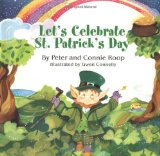 Let’s Celebrate St. Patrick’s Day written by Peter and Connie Roop, illustrated by Gwen Connelly
Non fiction picture book about St. Patrick’s Day published by Millbrook Press
Part of a series of “Let’s Celebrate” books, Let’s Celebrate St. Patrick’s Day answers questions children in the primary grades might ask. Who was Saint Patrick? Why do we celebrate St. Patrick’s Day in America? Why is everything green on St. Patrick’s Day? Young readers will have fun with the Irish-theme riddles featured on the end papers.
Lets Celebrate St Patrick’s Day at Amazon.com
Let’s Celebrate St. Patrick’s Day at Amazon.ca
May your blessings outnumber the shamrocks that grow,
And may trouble avoid you wherever you go.
~Irish Blessing
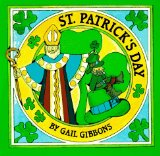 St. Patrick’s Day written and illustrated by Gail Gibbons
Non fiction picture book about St. Patrick’s Day published by Holiday House
As one might expect from Gail Gibbons, St. Patrick’s Day is thorough look at traditions associated with Saint Patrick and ways people celebrate March 17th. Clear, bold illustrations are well suited to a read aloud setting and compliment the text nicely. The treatment of Saint Patrick and his life is more complete than in other comparable non fiction titles and legends association with him are briefly touched on.
Suitable for children aged four years and up.
St. Patrick’s Day at Amazon.com
St. Patrick’s Day at Amazon.ca
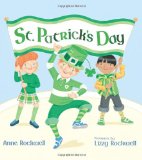 St. Patrick’s Day written by Anne Rockwell and illustrated by Lizzy Rockwell
Part of a series of “Mrs. Madoff” books, St. Patrick’s Day follows a young boy as he goes to school on St. Patrick’s Day. He and his racially diverse classmates are working on reports and they present their discoveries dramatically, musically, pictorially and in written form. Once the school day ends, Delicious soda bread awaits at home where the family’s Irish heritage is celebrated. Suggested for children aged five years and up.
St. Patrick’s Day at Amazon.com
St. Patrick’s Day at Amazon.ca
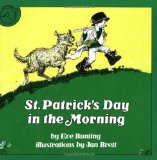 St Patrick’s Day in the Morning written by Eve Bunting and illustrated by Jan Brett
St. Patrick’s Day picture book published by Clarion Books, Houghton Mifflin
When Jamie is told that he is too young to walk in the St. Patrick’s Day parade, he takes matters into his own hands. He starts out before the rest of his family awakens. He dresses in his mother’s raincoat and his father’s hat. He takes his brother’s flute and the family sheepdog and, with great determination, heads to Acorn Hill.
They marched down the street. None of the chimneys was smoking yet. Milk bottles stood on front steps, waiting to be let in.
Encounters with neighbors are just one highlight of this gentle story of independence and growing up. Highly recommended for children aged four years and older.
St. Patrick’s Day in the Morning at Amazon.com
St. Patrick’s Day in the Morning at Amazon.ca
May your pockets be heavy and your heart be light, May good luck pursue you each morning and night.
~Irish Blessing
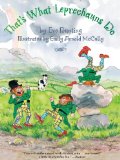 That’s What Leprechauns Do written by Eve Bunting and illustrated by Emily Arnold McCully
Picture book published by Sandpiper Books, Houghton Mifflin Harcourt
Boys and Girls will delight in this look at St. Patrick’s Day from the perspective of a trio of playful leprechauns. Boo, Col and Ari have important work to do but it is fun to make mischief and they can’t resist temptation.
Och, sure, but I couldn’t help myself. Mischief’s what leprechauns do,” Ari said. “Along with our more important duties.” He glanced up at the tatters of clouds in the sky. “And we better not delay, for we’ve delayed enough already.”
As rain clouds gather above gorgeous green fields, the leprechauns rush to place a pot of gold at the end of a rainbow. Great fun, That’s What Leprechauns Do includes some repetitive text and will appeal to children aged four years and up
That’s What Leprechauns Do at Amazon.com
That’s What Leprechauns Do at Amazon.ca
Very glad to be part of this week’s Kid Lit Blog Hop ~


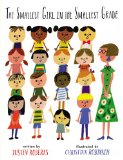 The Smallest Girl in the Smallest Grade written by Justin Roberts and illustrated by Christian Robinson







 ,
, 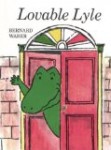
 by Bernard Waber has just the right message for Mary and her classmates.