
The Alphabet and Letter Sounds
Ways to promote letter recognition with preschool and kindergarten age children

An important step in learning to read is for children to name and quickly recognize letters. Children will need to memorize four sets of letters. Initially they will learn uppercase manuscript and lowercase manuscript. Later, they will also learn upper case cursive and lowercase cursive. Children will need to notice the differences amongst similar-looking letters ( for example E+ F, d+b, m+n, M+W). Children will also need to understand that there may be more than one symbol for a letter (i.e. g).
Ways to promote alphabet recognition and learning letter sounds with preschool and kindergarten age children. #parentchat #earlyed #earlyyears #learningletters Share on XOften alphabet recognition is acquired in the following sequence:
- Child is hears letter names (for example, when singing the alphabet song or hearing an alphabet book read by an adult)
- Child recognizes his or her name in print (for example, a child finds his name and then hangs his coat up on a hook)
- Child learns most letter names (perhaps beginning with the letters in her own name)
- Child recognizes the shapes and sounds of letters
- Child learns about the differences and similarities amongst letters
- Child begins to print her name and practices letter-writing
Activities You Can Use to Promote Alphabet Recognition
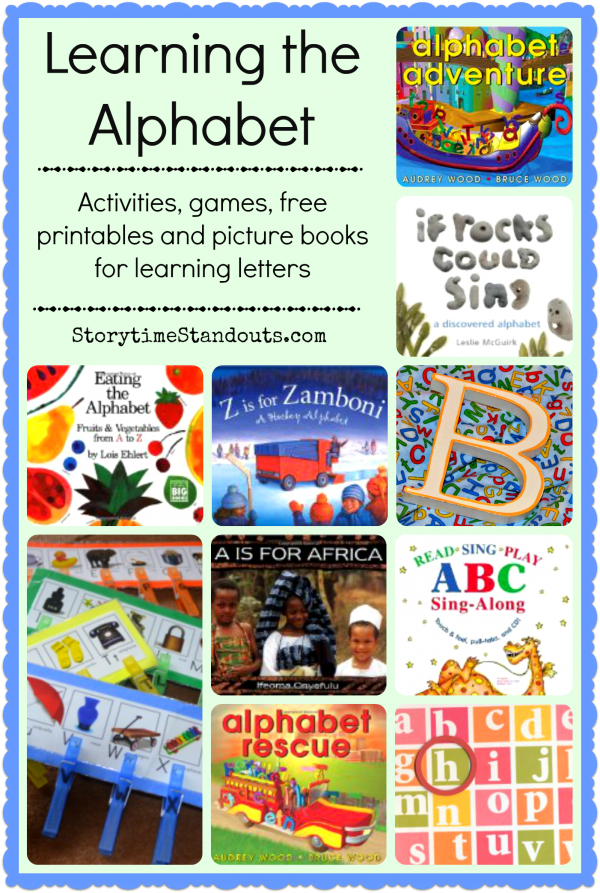
Click on the alphabet books to read about the books.
Sort letters – are they made of straight lines, curvy lines, or a mix? Only straight, only curvy, a mix of straight and curvy. Have a dot/don’t have a dot
- Search through a newspaper ad for a particular letter – ads with big, bold letters are best (draw a circle around letter you are seeking or, draw lines from a to b, b to c, etc.)
- License Plate Letter Hunt – when you’re in a car or walking along a street, look for a particular letter or, have a competition and see who can find the most letters. Don’t forget to check out license plates, signage, and people’s clothing,
- Touchy- Feely – place five or six wooden or magnetic (3 dimensional) letters in a paper bag. Have your child reach into the bag and pull out a particular letter. You can greatly increase the value of this game by talking about the letter shapes and coaching your child to notice similarities and differences.
- Gross motor – alphabet recognition can (and should!) involve the whole body. Encourage your child to use masking tape to make a huge letter or word on the floor.
- Use Sidewalk Chalk to create a path of letters along a sidewalk or driveway or put letters into a HopScotch game and name the letters before you hop!
- Memory – make game cards featuring two copies six or seven letters. Use upper case or lower case or a mix. You and your child can turn over the letters, search for a match. You can prompt your child to say the letter name and/or sound in order to win a pair.
- Tic Tac Toe – Print a letter in each square of a tic tac toe game. Ask your child to say the letter name before marking a square. Alternatively, you could play with different letters; instead of playing Xs and Os, you could play Es and Js.
- Letter Laceup – Cut out a cardboard letter shape and then use a hole punch to punch holes all around the outside of the letter. Give your child a long shoe lace to lace through the holes
- Make letter shapes using pipe cleaners, string, tongue depressors or building bricks.
- Kim’s Game – Spread a mix of plastic letters and/or alphabet blocks on a tray. Blindfold your child. Take one letter away. Ask your child to figure out which letter is missing.
- Magnetic Letters – Apart from using these on a refrigerator door, they can also be fun on a cookie sheet (in the car). All the previously mentioned sorting activities can be used. As well, your child can find the letters to spell his name, find the letters to spell familiar words or find the letters to match a license plate on the car ahead of you.
- Have a bowl of alphabet soup, pasta or cereal. Talk about it.
- Make the alphabet a tactile experience. Draw letter shapes in shaving cream, sand, cornmeal or mud. Get dirty!
- Do Dot-to-Dot Puzzles
- Alphabet Singalong – Many alphabet books include a one or two page alphabet on the inside front cover. Sing the alphabet song and point to each letter as you sing the letter names. Talk about the fact that L M N O P = five letters!

- Create your very own Alphabet Game Board. This is very easy to do especially as alphabet stickers are widely available. Create your own path and put an alphabet sticker in each ‘space’. Add a couple of ‘go ahead 2 spaces’, ‘go back 2 spaces’ and ‘miss a turns.’ Use a die plus one marker for each player. Older players can be asked to say the letter sound. Younger players are asked to say the letter name only. Still older children are asked to say a word that begins with the letter or a noun/verb/adjective/adverb that begins with the letter.
- Computer Font Fun – Use your computer word processor to create game cards. Print four versions of five or six letters. Use a variety of wild fonts. Have your child sort the game cards, matching the letters.
- Make an alphabet collage and play I Spy – cut out bright, bold, colourful letters and glue to a piece of cardstock. Play, ‘I Spy a blue letter that is very curvy.’
Some of our Most Popular Alphabet Recognition Posts
Hover over the photo for a description of the activity. Click on the photo to read the full post
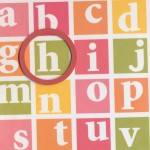
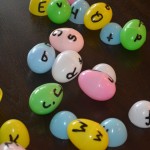
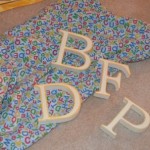
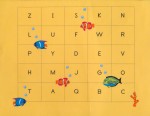

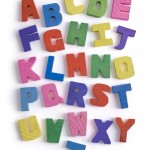
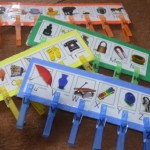
Free Alphabet Printables for Preschool, Homeschool and Kindergarten

Our early learning printables, including our alphabet printables are in PDF format, if you don’t already use Adobe Reader, you will need to use it to access our free downloads.
You will find a larger selection of free printable alphabets here and all of our free early learning printables here.
Click the image to download a copy of the Alphabet Song | |
 | |
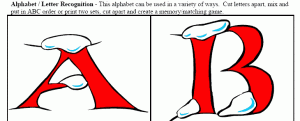
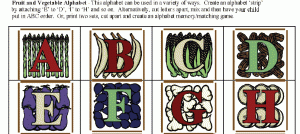
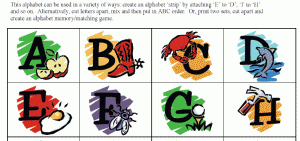
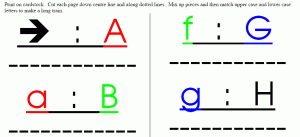
Click the image to download a Free Printable Alphabet or Alphabet Dominos | |
 |  |
 |  |
 |  |
Our Alphabet Learning Pinterest Board