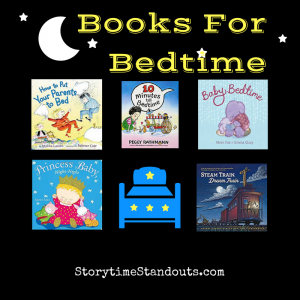
Finding the perfect bedtime story can make all the difference as toddlers and preschoolers settle down for the night. In this post, we have a look at some delightful bedtime-theme children’s books that will set the tone for a good night’s sleep. In the comments, we hope you’ll let us know about your favorite books for bedtime!
In this classic, fun picture book, Dad cautions his son that it is 10 minutes till bedtime. Within a moment, a pet hamster has summoned other neighborhood hamsters to stop by for ten minutes of fun. Preschool-aged (and older) children will enjoy the detailed and engaging illustrations that tell most of the story. Of course, the joke is on Dad as he has no idea what is happening behind his back, as his son gets ready for bed. Good fun and a great opportunity for language and comprehension development. Carefully ‘reading’ the illustrations and talking about what is happening is a big part of this bedtime story.
Soft tones and sparse, rhyming text are hallmarks of this gentle picture book about a baby elephant’s bedtime. Cuddling and smiling, an adult elephant takes a baby elephant through a bedtime routine (including a story!) before finally saying goodnight.
One of the really lovely aspects of this picture book is that the gender and age of the adult elephant is not specific. This could be a mom, dad, grandparent, aunt or uncle putting the youngster to bed.
Wonderful rich vocabulary and onomatopoeia make this a wonderful bedtime story for preschool-age and older children. Children who are interested in trains, will enjoy hearing the names of the various cars (hopper, tender, reefer, gondolas etc.) and will hear the rhythmic text that echoes the sounds we associate with steam trains.
Set in moonlight, Mr. Lichtenheld’s illustrations, created with wax oil pastel are beautifully atmospheric. We especially liked the train’s arrival and the child’s moonlit bedroom.
How to Put Your Parents to Bed written by Mylisa Larsen and illustrated by Babette Cole Fun picture book about bedtime published by Katherine Tegen Books, an imprint of Harper Collins Publishers
Preschool-age and older children will enjoy the humor as a young girls tries to get her parents to go to bed. Chores, a computer, games, television and even cell phones are delaying mom and dad’s bedtime but, with determination, it is possible for her to get them settled and off to sleep.
Older children, especially those who resist shut-eye, will see themselves in this fun role-reversal tale.
Getting ready for bed can be an exhausting proposition. Princess Baby has lots to do. She not only puts her own pajamas on, she dresses her six special friends for bed too. She also helps with washing up, brushing teeth and selecting stories.
Bright, beautiful collage illustrations make this a great story to share in a group setting. Fans of Princess Baby will want to explore Princess Baby and Princess Baby on the Go.
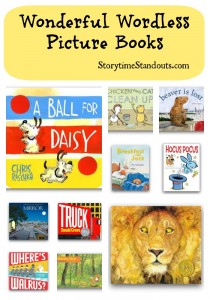
From my perspective, wordless picture books are an under-appreciated genre. “Readable” in any language (or multiple languages), they help children to develop comprehension skills and they can be used to prompt discussion and encourage language development.
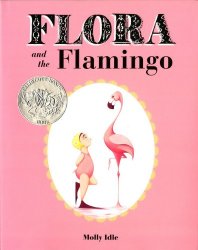
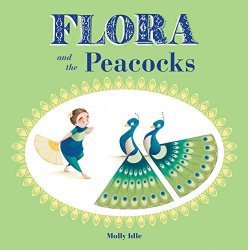
Last week, I had the pleasure to read two wordless picture books by Molly Idle. Floral and the Flamingo was published in 2013. Flora and the Peacocks was published this year. Flora and the Penguin was published in between.
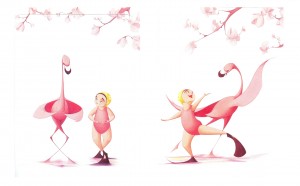
Floral and the Flamingo begins when a young girl approaches a statuesque flamingo and takes her cues from the bird. Soon it appears that the flamingo is challenging the girl to match her posture and form. Floral is up to the task. She stands on one leg, she arches her back, she stretches and poses. Before too long, the flamingo and Flora are dancing together and loving every moment of the experience.
A truly lovely picture book that uses flaps beautifully, this will have special appeal for fans of ballet. Delightful illustrations are wonderfully expressive and will create an opportunity to talk about Flora’s emotions as she does her best to match the graceful flamingo’s movements.
Flora the Flamingo was a 2014 Caldecott Honor Book
The third book in Ms. Idle’s series, Flora and the Peacocks adds another dimension to her storytelling. In this wordless picture book, Flora introduces herself to two peacocks. One of the peacocks appears quite happy to have a new friend but the other is not keen at all. The trio struggles to find a way to find harmony and to be friends.
Dramatic illustrations highlight gorgeous blue, green and gold peacock feathers and the especially the facial expressions of the three characters. Young readers will want to talk about why it was difficult for Flora to join the two peacocks and how their behavior changed over the course of the story.
Whether planning a day at the beach or just back from some fun in the sun, these beach-theme picture books will be a wonderful addition to your summertime fun. Suitable for toddlers, preschool age children, kindergarten and older, these stories address important themes like fear of the water and getting outside one’s comfort zone. Whenever possible, it is very valuable to have children read books that match their experiences. These stories are perfect for introducing new concepts and extending learning. Have fun!
We hope you’ll also want to check out our post about summer fun – it includes free summer-theme printables.
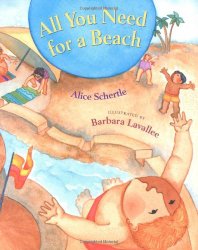
All You Need for a Beach written by Alice Shertle and illustrated by Barbara Lavallee
Picture book about a day at the beach published by Harcourt, Inc.
A companion book to All You Need for a Snowman, this is an exuberant celebration of a group of children, playing together in sand and water. Bright, cheerful colours and a happy theme of exploration and cooperation highlight this picture book for toddlers and preschool-age children. Illustrations depict a racially diverse group of children.
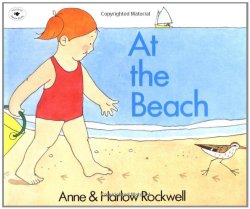
Best suited to very young children, At the Beach is a lovely introduction to the joys of spending a day picnicking, playing in the sand, looking for treasures and swimming. Simple, clear text matches the colorful illustrations and creates an opportunity for learning new vocabulary.
The main characters are a Caucasian girl and her mother however the illustrations depict diverse skin tones among those playing at the shoreline.
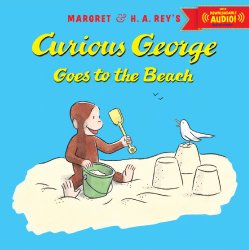
Curious George Goes to the Beach based on the original character created by Margaret and H.A. Rey, illustrated in the style of H.A. Rey by Vipah Interactive Picture book about a day at the beach published by HMH Books for Young Readers
Fans of Curious George will not be disappointed with this fun story about a day at the beach. George and his friend Betsy enjoy playing at the sandy beach, making friends and feeding the sea gulls. Betsy’s reluctance to go into the water could be an opportunity to talk about fear of new experiences.
Betsy, her grandmother and the man with the yellow hat Caucasian however the illustrations depict diverse skin tones among those at the beach.
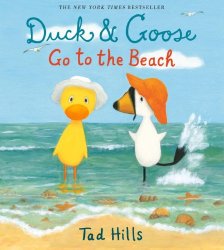
Duck and Goose Go to the Beach written and illustrated by Tad Hills Picture book about friends who visit the beach published by Schwartz & Wade Books
Duck is keen for adventure while Goose would much rather stay in familiar surroundings so it is only not surprising that Goose is not keen to go for a hike. The two friends leave their familiar meadow and eventually arrive at the beach. It is loud and wet and very, very sandy. Vibrant illustrations are a highlight of this engaging story about two friends leaving their comfort zone, enjoying a day out together and then returning to the comfort of home. Duck and Goose Go to the Beach is highly recommended for preschool- age children.
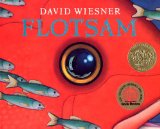
In this wordless picture book, we join a boy and his family as they spend a day at the beach. Clearly an enthusiastic scientist, he arrives equipped with binoculars, a magnifying glass and a microscope. As he searches for interesting ‘flotsam’, a huge wave crashes over him and leaves an old underwater camera just above the waterline. The boy races to a nearby shop and waits as the film is developed. When handed the photos, he can’t believe what they reveal. Flotsam is truly a ‘treasure chest’ of visual delights.
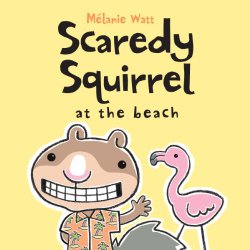
Scaredy Squirrel at the Beach written and illustrated by Melanie Watt Beach theme picture book published by Kids Can Press
Scaredy Orville Squirrel whose initials are S.O.S. is an immensely popular character in an equally popular series of picture books.
In Scaredy Squirrel at the Beach Scaredy the worrywart is very careful to avoid any sort of real or imagined danger. Rather than encounter pirates, jellyfish, seagulls and sea monsters, he decides to create his very own private backyard beach paradise. After carefully constructing his safe haven, Scaredy realizes that, although his beach “look” is great – his backyard just doesn’t sound like the real thing. The only solution is “Operation Seashell” – a carefully planned and executed mission in search of a seashell that will provide crystal clear ocean sound. Featuring detailed descriptions of Scaredy’s beachware and plans for his mission, Scaredy Squirrel at the Beach will be enjoyed best independently or in a small group or one-on-one read-aloud setting. Best-suited to children five and up.
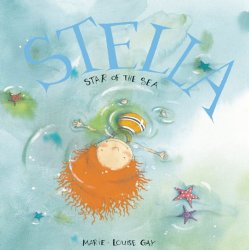
Stella Star of the Sea written and illustrated by Marie-Louise Gay Picture book about a summer day at the seashore published by Groundwood Books
In this endearing series of picture books, we meet confident and worldly Stella and her much less self-assured younger brother Sam. When the two children visit the seaside on a shimmery summer day, Sam is filled with questions that suggest not only curiosity but also a bit of fear,
“Do you think there are sharks in the sea?” asked Sam.
“Have you ever seen one?”
“Just a little one,” said Stella, “with an eyepatch.
Are you coming, Sam?”
“Not just this minute,” said Sam.
Gorgeous illustrations together with text that beautifully depicts the two siblings will have young children longing to visit the seashore and discover all the wonders of a leisurely summer day filled with digging in the sand, fishing, beach combing and, eventually, a swim.
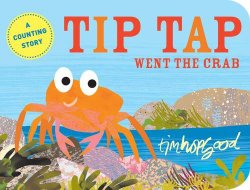
Tip Tap Went the Crab written and illustrated by Tim Hopgood Counting book about sea creatures
Tip Tap Went the Crab features bright and colorful illustrations along with repetitious text that includes alliteration and onomatopoeia. When a crab decides to leave her small rock pool to explore the ocean she encounters one seagull, two sea lions and three starfish.
A great choice for toddlers and preschoolers, Tip Tap Went the Crab provides a great reminder that books for this age group can (and should) include rich language and fun, detailed and appealing illustrations. It is well-suited for a classroom or library read-aloud session.
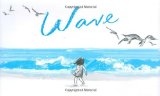
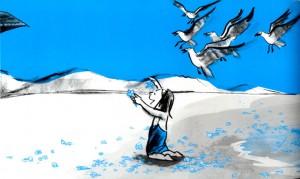
When a young girl arrives at a beach, she is filled with enthusiasm and dashes forward, stopping just short of the beautiful, frothy blue water. She hesitates on the sand, pausing, leaning as she is drawn toward the ocean. Suddenly, the character of the water changes. Worried, she tentatively shifts backward, her steps mirrored by a group of friendly gulls. As the waves reverse and retreat, our young heroine stands on her tip toes and challenges the salty water. Before long, she leaps into the dancing waves, joyfully kicking and splashing until an enormous wave erupts. The powerful crest leaves her sodden but excited when it deposits a bounty of shells on the sandy beach.
Children and adults will revel in this playful, wordless celebration of a day at the beach.
Gorgeous illustrations were created with charcoal and watercolours. Suitable for all ages.
Wave was selected New York Times Best Illustrated Children’s Book 2008
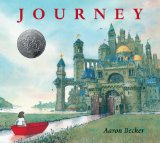
Journey is Wondrous, beautiful, inspiring, magical
–
So many words could accurately describe this books for children. A wordless picture book, Journey is the story of a city-dwelling girl whose family members are occupied with chores and technology. As she sits, bored and perhaps lonely, on the front stoop, a neighboorhood boy stands nearby, holding a purple crayon. She goes inside the house and tries to engage her family members in play but they are busy. Disappointed, she goes to her bedroom. Moments later, she notices a red crayon on the bedroom floor. She picks it up, draws a doorway on her bedroom wall and escapes her boring, sepia-toned environment. Soon she is surrounded by gorgeous, glowing colors. Her magical red crayon allows her to create a rowboat, a hot air balloon and a magic carpet as she explores a mystical word, filled with unusual people, intriguing buildings and fascinating machines.
In this wondrous world, she encounters the neighboorhood boy with the purple crayon, the circle is completed and she discovers a new friend.
Highly recommended, this book will be appreciated most by children aged four years and up. As well, adults will be inspired by both the illustrations and the narrative.
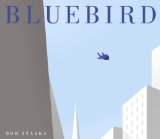
A small bluebird flies through a city, past an apartment building and toward a school. The bird perches in a tree and watches as a young boy approaches the school. Unlike the other students, he walks alone with his eyes turned downward. Whereas other children chatter happily with their friends, he is slow to walk into his new classroom and take his place. Once he is seated, two classmates laugh and point. For some reason, he is a lonely outcast and the object of ridicule.
The hours tick by and, when the boy leaves school, he is surprised when the friendly bluebird initiates a friendship. The bird chirps at him and follows him through an urban neighborhood. They play hide and seek, they share a cookie, they watch as a group of children play soccer and they arrive at a park where the boy floats a sailboat in a pond. There is time for happy daydreaming and exploring before their adventure takes an ominous turn. The boy and the bird approach a wooded area and are soon met by three miserable bullies. One wants his toy sailboat and, to add force to his threats, he throws a stick, hitting the swooping bluebird. As the violent bullies run from the scene, the bereft boy stands, holding the injured bird.
Highlighted by light blue, grey and white Adobe Photoshop-rendered illustrations, Bluebird is best suited to children aged five and up. With an ending that is open to interpretation, the author-illustrator leaves many questions unanswered. The boy is very much a solitary figure, we don’t know why he is on his own in a large city. We also don’t know why he is ridiculed by his classmates and bullied by the children in the park. This is not a story that satisfactorily resolves bullying rather it is a celebration of friendship. Young readers will have questions and opinions. They will engage in the narrative and, with encouragement, will think about the impact of bullying behavior.
For the past six weeks, I have been working with a four year old girl who is learning English as a second language and who has a speech delay. We meet once each week for one hour.
I have been using a variety of materials and techniques to support her learning. Today I thought I would highight a few of them.
Wordless Picture Books
During each of our sessions, we read one or two wordless picture books. These are books that have little or no text. Readers use picture clues to decide what is happening in the story. Wordless picture books invite discussion because, as you turn the pages, the story unfolds and there is plenty of opportunity for meaningful talk.
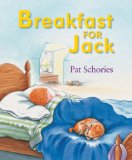
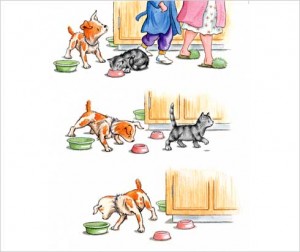
Although we have read several wordless picture books together, Breakfast for Jack has been our favourite. The book is a good size for sharing one on one. The story is relatively simple and yet the illustrator has included many interesting details. It is morning, the sun is rising. Jack wakes up and stretches. Soon Boy is awake. He and Jack go downstairs. Boy feeds the black and grey cat but, each time he starts to get Jack’s breakfast, he is distracted. Poor Jack is very hungry.
When my young student and I first started reading Breakfast for Jack together, she was only able to talk about small snippets of the story because of her speech delay and limited vocabulary. Now she explains that Jack is orange and white, the cat is black and grey, Boy wears purple pyjamas. We talk about the family’s breakfast of toast and cereal. We also talk about the cat enjoying a bowl of milk and then snoozing under the telephone table.
Breakfast for Jack is engaging. The illustrations ensure that the reader understands exactly what is happening. The story and illustrations draw young readers in and keep those same readers involved in telling the story.
Puppets
Since Breakfast for Jack has become a favourite, last week I added dog finger puppets to our session. You may be aware that hand puppets and finger puppets are frequently used for play therapy because children often feel safe using a puppet to express themselves. In working with a child with a speech delay, it seems very logical to include puppets and encourage her to play with them. On Thursday, our three little dogs played together, they talked and raced at the park.
Illustrated Vocabulary
Keeping in mind that my student is not only dealing with a speech delay, she is also learning English as a second language. Each week I prepare one page of vocabulary that is related to a theme. The page introdues nine words that are illustrated and related by theme. We have done ‘Weather Words,’ ‘Things Families Do,’ ‘Clothing Words,’ ‘In My Neighbourhood,’ ‘Valentine’s Day,’ etc. We review all of the vocabulary each week. As well, she reviews the vocabulary at home each week. Her progress with these words has been quite dramatic.
Rebus Poems
Each week we add a new rebus poem to our program. Usually the poem is related to the vocabulary we are learning. For example, when I introduced ‘Weather Words,’ I created a rebus version of ‘Itsy Bitsy Spider.’ When I introduced ‘Things Families Do,’ we learned ‘Grandma’s Glasses.’ I like using rebus poems with young children very much. We track the text with our fingers (reinforcing that we read left to right and top to bottom). When reading rebus poems, we use picture clues to help us remember the poem / chant, we hear rhyming and we learn new vocabulary.
My young student’s mom and I are thrilled with the progress she has made to date. She is an enthusiastic learner and she is happy to enjoy stories, chants and learning new words. Next week, I will write again about our session together.
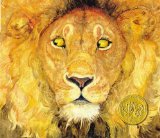
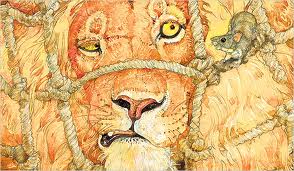
The story of the lion and the mouse is an Aesop’s fable that every child ought to know well. The lion, powerful and dangerous resists an opportunity for bullying and, instead, is kind to a small mouse. Later, when the lion is trapped in a hunter’s net, the grateful mouse has an opportunity to return the favour. He chews the rope net and eventually manages to free the lion.
Jerry Pinkney has created a masterful, almost wordless picturebook version of The Lion and the Mouse. From cover to cover, beautiful illustrations depict the African Savanna and the animals found there while telling the story of a compassionate lion and his small friend. Winner of the 2010 Randolph Caldecott Medal and also a New York Times 2010 Best Illustrated Book and a 2010 Horn Book Awards Honor Book, The Lion and the Mouse relies upon the illustrations to tell the story. Pinkney only uses words to describe animal sounds.
Highly recommended for both classroom and home libraries, The Lion and the Mouse could be used to explore many themes including anti-bullying, friendship and stereotying.
Bear and Rabbit are just sitting down for a meal when one of their chicken friends is scooped up by Fox. Shocked at the brazenness of Fox’s thieving behavior, Bear, Rooster and Rabbit are outraged and are soon in hot pursuit.
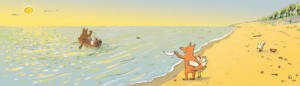
Before long, Fox and Chicken have entered the deep, dark woods and Rabbit, Bear and Rooster are tiring. When they bed down for the night, Chicken can see her friends, in the moonlight. The following day, Chicken is remarkably relaxed, playing checkers with Fox and sleeping curled up, next to her abductor. The chase continues and as she and Fox take off in a boat, she does not look the least bit frightened. In fact, she wears sunglasses and reclines comfortably at the bow. When her three bedraggled friends finally catch up to Fox and Chicken, they are ready for a fight and surprised at what they discover.
Youngsters will thoroughly enjoy carefully examining the small details included in the ink and paint illustrations. Great fun for preschool and up.
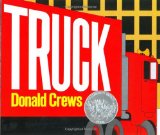
Storytime Standouts looks at an almost wordless picture book, Truck by Donald Crews
Truck created by Donald Crews Almost wordless picture book published by Greenwillow Books, an imprint of Harper Collins Publishers
When my boys were young, books about trucks and other large vehicles were enormously popular with them. I don’t know how many times we read Truck Song by Diane Siebert and Cars and Trucks and Things That Go by Richard Scarry. Anything with more than four wheels had incredible appeal. Road construction was similarly exciting and stopping to watch an excavator or a paving crew could become the highlight of our day!
Truck tells us the story of a large, red semi trailor truck that is transporting a load of bicycles. The distinctive vehicle leaves one city, rumbling through a tunnel and eventually travelling overnight. Miserable weather and other trucks accompany the red semi trailor filled with bicycles to a rural highway. Children will love the busy interchange and the foggy roadway leading up to a bridge and the approach to another city.
Young transportation enthusiasts will enjoy “reading” the roadsigns, learning about direction and examing the other vehicles as they follow the big read truck on its journey.
Highly recommended for truck lovers ages three and up.
Truck was as ALA Notable Children’s Book and a Caldecott Honor Book. It is available in a variety of formats including board book.
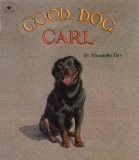
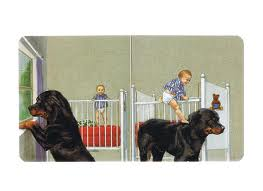
This immensely popular almost wordless picture book will be thoroughly enjoyed by dog lovers and young mischief makers. When mother goes out for awhile, she asks her pet rottweiler, named Carl, to look after the sleeping baby.
Carl watches at the window as Mother leaves and then lowers the crib rail and waits patiently while Baby Madeline climbs onto his back. Carl provides loving care for the infant, bouncing her on Mother’s bed, playing dress up and meeting her at the bottom of the laundy shute. When the baby goes for a dip in the family fish tank, Carl is nearby, ensuring that she is swimming safely. Eventually Carl makes lunch for Madeline, returns her to her crib and tidies the house thoroughly before her unsuspecting mother returns home.
Once readers get over their shock at the idea of leaving an infant at home alone with a dog, they will enjoy the silliness alongside Carl’s gentle and devoted caregiving. Carl is utterly loveable and Baby Madeline is clearly having a grand time.
Good Dog, Carl is the first of seventeen wordless picture books about Carl and Madeline. Available in a variety of formats including board book and paperback, the hardcover measures 7.6 x 8.5 inches and is designed appropriately for small hands to grasp. Suitable for toddlers and preschool-age children.
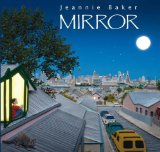
Storytime Standouts looks at an almost wordless picture book about families. One family lives in a village in Morocco and and the other lives in Sydney, Australia.
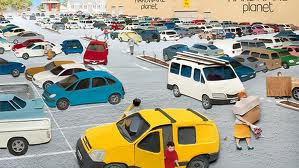
Designed to be read side by side, Mirror is essentially two picture books. Once the reader opens the cover, she discovers a wordless picture book about an Australian family on one side and a parallel story about a Moroccan family on the other. Both stories begin at dawn.
We meet an Australian boy who lives comfortably in the suburbs with his mother, father and a baby. After breakfast, he and his dad climb into the family van and drive on crowded streets to ‘Hardware Planet.’ They buy construction materials and a beautiful woven carpet.
The Moroccan boy’s day begins with a breafast of fresh eggs, plucked from a hen’s nest, and milk just collected from the family cow. After breakfast, he and his father pack up a handmade carpet, climb onto a donkey and travel dusty roads to an open-air market. Once at the market, they make a trade that will likely surprise and delight young readers.
Mirror features remarkable collage illustrations and a fascinating concept. The book will be enjoyed by children aged five and up and offers ample opportunities for discussion including how individuals and families are alike and different and how seemingly very different cultures may not be “different” at all.
Mirror includes introductory comments and afterwords written in English and Arabic.
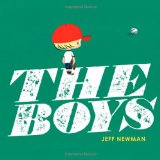
When a young lad moves houses with his family, he is anxious to find a baseball game in his new neighbourhood. He unpacks his baseball glove, bat and spikes and ventures out into the neighbourhood.
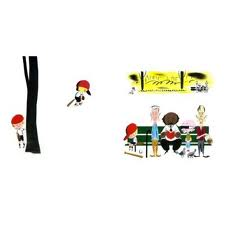
Once he arrives at the park, he hesitates, watching some children from afar. Rather than joining the kids’ game, he is dejected. He slowly approaches a park bench and sits down. Four aging men are already seated, feeding the pigeons.
The following day, the disappointed boy stores his baseball gear away and joins the men sitting on the bench. He helps to feed the pigeons.
The men take note of his appearance when he joins them on the bench a third time. He looks old – probably much older than they feel! It is time for action.
The men give up sitting on the park bench, instead playing on the playground monkey bars and the slide. They are smiling and laughing. They have been transformed. When a bike awaits the boy the following day, it is clear the men think it is time to get moving – they climb onto bikes, a scooter and a wagon, annoying the pigeons and our boy. He just wants to sit.
Little does he know, a plan is afoot. On Sunday the men will play a baseball game. They supply a batting helmet and a bat, and watch as their hesitant young friend hits one “out of the park.”
Confidence regained, the youngster approaches the boys and girls playing at the park and joins their baseball game. The cronies cheer from the stands.
There is much to love about The Boys . Boldly illustrated, the almost wordless picturebook introduces themes of social isolation, self confidence, ageism and the value of play. Readers will find it both thought-provoking and reassuring.
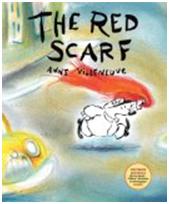
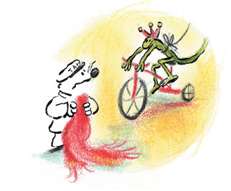
Turpin’s day is altogether too gray until an imposing figure climbs into his taxicab. Turpin delivers the gentleman to his destination and shortly thereafter discovers a bright red scarf on the seat of the cab.
Turpin chases after the mysterious man but is detained by a lizard on a unicycle. Once he explains his purpose, the lizard allows him to pass. Turpin soon finds himself surrounded by a bear on roller skates, and a ravenous lion. Fortunately, the lion tamer is not far away and rescues him before the worst can happen.
Now, surrounded by amazing colour and exotic creatures, Turpin’s day grows stranger and stranger until he finds himself in the middle of a brightly lit circus tent. A parading elephant, a fire breathing juggler, a playful monkey, a tightrope and a magic trick all add to the hijinks as Turpin struggles to return the scarf.
Originally published as L’echarpe rouge, this almost wordless picture book won the 2000 Governor General’s Literary Award for Children’s Illustration.
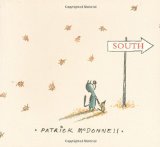
The Mutts comic strip appears in over 700 newspapers and Mooch the Cat is one member of a diverse “cast” of characters appearing in the cartoons. Whether you are a fan of the comic strip or not, South and Mooch are sure to charm you in this gentle story of friendship and acceptance.
As the last leaf detaches from a tree, a large flock of yellow songbirds lifts to the sky. It is time to head South for the winter. The golden leaf slowly drifts downward until it lands on a snoozing bird. Awakened suddenly by the intrusive leaf, the drowsy bird is shocked to discover an empty tree. Where is the flock? Agitated and suddenly very lonely, the bird seeks help from Mooch and is devastated to learn that the flock has left for warmer climes.
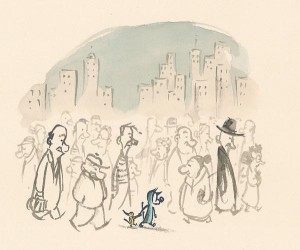
Mooch pauses, thinks and extends his paw. Mooch will help the errant bird find the flock. Together, the two unlikely friends travel through a busy city, into a forest and through a snowstorm as they search for the flock. At times, Mooch carries the tired bird on his back. The unexpected friendship between the two deepens. When the weary pair finally hear the sweet sounds of the songbirds, they share a tender moment before parting company. Satisfied, Mooch returns home and curls up by a welcoming fire. Winter has arrived and his job is done.
South themes include loneliness, kindness, friendship and social responsibility. Printed on recycled paper, the almost-sepia tones match the mood and a story set in Autumn beautifully. Well suited to children aged four and up, South will be equally enjoyed by adults.
Jack is an adorable orange and white terrier, brimming with personality. One busy morning, his family gets up, feeds the cat, eats breakfast and rushes off to school and work. Sadly, no one remembers to feed Jack. He is completely bewildered by the situation and he does his best to remind them that he is hungry. It is not until they are all out the door that his best pal remembers to feed him.
The Jack series is a great introduction to the wordless picture book genre. Relatively simple storylines will be easy for youngsters to understand. As well, the size of the books (7″ wide X 8 1/2″ high) makes them well-suited to small hands. Best for children aged three years and up.
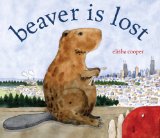
When beaver floats away from his dam and his three friends, he soon finds himself surrounded by hardworking people and their enormous machines. The workers are loading lumber onto a truck.
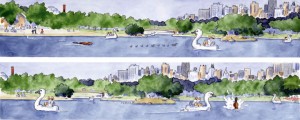
Beaver hops aboard a fully loaded truck and hitches a ride to the city. Once there, he scampers away from the truck. A snarling dog chases him through a hole in a fence and into a backyard. Leaving his new enemy behind, Beaver swims through an alligator-toy infested pool and is eager for further adventures. It is not long before he discovers the city zoo and some distant relatives. Escaping a surprised zookeeper, he dives into a duck pond on his way into the busy city.
Our ever-resourceful new friend is not one to shy away from drainpipes, crowds of people, stairways or bodies of water. Happily, as the sun sets, his exploits lead him to a familiar river and a welcome home. Readers are left to wonder whether Beaver was truly lost – perhaps he just possesses an adventurous spirit.
Beautiful watercolour cityscapes and waterscapes together with fast-paced frames and an engaging story highlight Beaver is Lost. Highly recommended for children aged four and up.
For older children, possible extension activities for this almost wordless picture book could include devising further exciting adventures downstream.
It hardly seems right to attempt to capture the infectious spirit and joy of Suzy Lee’s Wave with mere words but I shall try.
When a young girl arrives at a beach, she is filled with enthusiasm and dashes forward, stopping just short of the beautiful, frothy blue water. She hesitates on the sand, pausing, leaning as she is drawn toward the ocean. Suddenly, the character of the water changes. Worried, she tentatively shifts backward, her steps mirrored by a group of friendly gulls. As the waves reverse and retreat, our young heroine stands on her tip toes and challenges the salty water. Before long, she leaps into the dancing waves, joyfully kicking and splashing until an enormous wave erupts. The powerful crest leaves her sodden but excited when it deposits a bounty of shells on the sandy beach.
Children and adults will revel in this playful, wordless celebration of a day at the beach.
Gorgeous illustrations were created with charcoal and watercolours. Suitable for all ages.
Wave was selected New York Times Best Illustrated Children’s Book 2008
Regular readers of Storytime Standouts will know that I am a fan of wordless and almost wordless picture books. When an adult shares a wordless picture book with a child, the adult loses the “reading advantage.” In a wordless picture book, there are almost no words to read. The story is told through the illustrations so both adult and child can partner to “read” the story and decide what it is all about.
Wordless picture books are great for vocabulary development because they encourage co-readers to discuss the illustrations as they move through the story. Wordless picture books are terrific for multi-lingual families because they can be enjoyed in any language. Additionally, wordless picture books provide a non-reading child the opportunity to “read” the illustrations and retell a story. Learning to “read” illustrations and retell stories are valuable skills for pre-readers and beginning readers to develop.
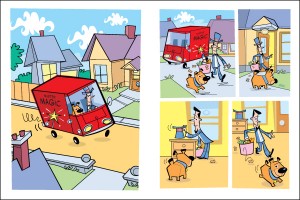
Hocus Pocus – story by Sylvie Desrosiers, illustrations by Rémy Simard Wordless picture book published by Kids Can Press
When Mister Magic arrives home with his top hat, Dog and a bag full of groceries, he is ready to relax. He puts on headphones, sits in a comfortable chair and listens to music. Before long, Mister Magic and Dog are both fast asleep and Hocus Pocus, a mischievous rabbit is scrambling out of Mister Magic’s top hat. Hocus Pocus sees Mister Magic’s carrots peeking out of the grocery bag and wants one. He worries about awakening Dog and is soon plotting ways to avoid the canine and his sharp teeth.
Retro illustrations (created with Adobe Illustrator) and the messy, farcical battle between Dog and Hocus Pocus give the story a cartoon-like feel. Hocus Pocus is great fun and will be enjoyed by children aged four and up.
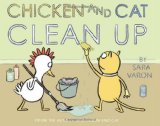
Chicken and Cat Clean Up written and illustrated by Sara Varon Wordless Picture Book published by Scholastic
If you have not yet enjoyed a wordless picture book with your child(ren), I would like to introduce you to this genre. “Reading” wordless picture books together with your child stimulates language development because the “reader” takes an active part in telling the story. Once you and your child have “read” the story from beginning to end hopefully your child will enjoy the opportunity to retell the tale – a key reading readiness skill.
In Chicken and Cat Clean Up we follow the misadventures of two dissimilar friends who operate a housekeeping business. Chicken is an excellent housekeeper but Cat is repeatedly challenged by the job. The bright, cheerful illustrations provide a fun account of operating a small buiness, an enduring friendship and how an opportunity for heroism might be just around the corner. Really good fun!
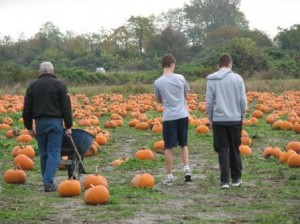
What could your child tell you about this picture? Would she say that it is Fall? Would she predict that the family is choosing a pumpkin for Halloween?
Two of the components of a child’s reading readiness are her comprehension and her interpretation. We can assist a preschool or kindergarten child with reading readiness by providing opportunities for him to read pictures and interpret them, including understanding the sequence of events.
Reading and interpreting pictures includes noticing what is in the picture, what the characters are doing, the weather or time of day and other details (i.e. the color of a character’s clothing). A child could be asked to interpret the scene and confirm comprehension by telling or retelling the narrative.
For the first picture, we could ask questions such as what do you think these people are doing? or why do you think the man is pushing the wheelbarrow? or Why do you think these people are visiting a pumpkin patch?
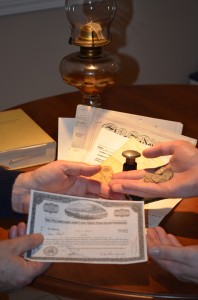
How would your child interpret this picture? Would your child notice the old oil lamp?
Why does one man have gold coins in his hand? or Do you see anything that looks usual in this picture?
Wordless Picture Books Encourage Children to Interpret and Comprehend
Wordless picture books are great tools for helping children to develop good comprehension and interpretation skills. We invite you to visit our Wordless Picture Books page to discover why great wordless picture books make narratives easily understood. Once a child has ‘read’ a wordless picture book with an adult, he should be encouraged to share the book with someone else. Making an opportunity to reconstruct and retell a story is valuable for a young child because reconstructing and retelling a story is a way to confirm comprehension.
Sequencing Activities = Reading and Interpreting Pictures
Children who have learned to ‘read’ and ‘interpret’ pictures will benefit from sequencing activities. These provide children with the opportunity to ‘read’ pictures and determine the correct order of events. Here are links to three printable sequencing activities from my website and three from elsewhere on the internet.
Valentine's Day Sequencing Activity
Cut this Valentine's Day Sequencing Activity apart and have children put it together in the correct order or print two and use as a matching game.
We NEVER get paid to review products on this site.
In some cases, I receive books to review free of charge. In other cases I review books that I have purchased or have borrowed from a public library. Whether I receive a book free of charge or not does not influence my review.
If you have questions or concerns about our policies, please do not hesitate to email for details.
Tales of a Fourth Grade Nothing by Judy Blume
Series for ...
Translate »
We use cookies to ensure that we give you the best experience on our website. If you continue to use this site we will assume that you are happy with it.OkNoRead more
You can revoke your consent any time using the Revoke consent button.Revoke Cookies



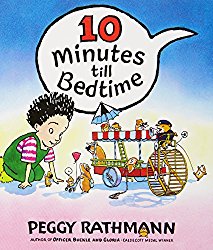 10 Minutes till Bedtime written and illustrated by Peggy Rathmann

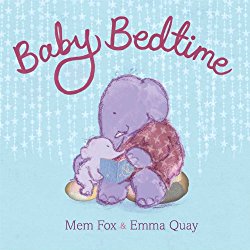 Baby Bedtime written by Mem Fox and illustrated by Emma Quay

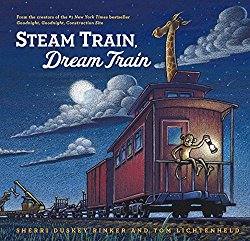 Steam Train, Dream Train written by Sherri Duskey Rinker and illustrated by Tom Lichtenheld

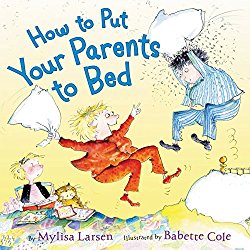 How to Put Your Parents to Bed written by Mylisa Larsen and illustrated by Babette Cole

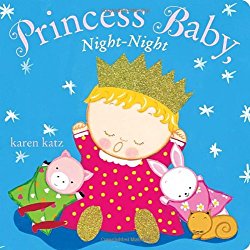 Princess Baby Night-Night written and illustrated by Karen Katz