If everybody who works at school is so smart, how come they can’t get rid of the bullies? How come when it comes to bullies, kids are mostly on their own?
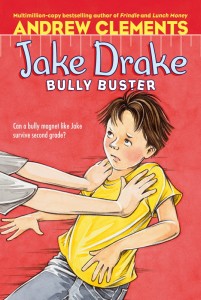
From the time he was in daycare, Jake Drake has encountered bullies of one kind or another. When he was three, a bully not only stole his cookies, he forced him off the swing. In kindergarten, Jake knicknamed another bully “King Bump” because he would shove him at inopportune moments. When Jake was a little older, he encounted yet another sort of bullying: the grade one bully liked to hit things near to Jake. Jake lived in fear of “The Fist.”
Jake has given bullying considerable thought. He has decided that he attracts bullies because of his size (he is not too big), the fact he does not have an older sibling, his unwillingness to tattle and the intellectual challenge he represents.
Jake is excited to start grade two and all is well until Link Baxter joins the class. Initially Link torments Jake by shaking his desk during a handwriting lesson. Classroom trouble soon moves to the school bus and Jake is understandably upset by the time he arrives home from school. His younger sister Abby encourages Jake to think about the bully. She points out, Its not fun to feel mean.
Overnight Jake strategizes and decides to “play it cool.” He will not react to Link’s taunting and teasing. He will not show Link that he is bothered. Jake’s plan works until Link takes his bullying to another level and pours water on the front of Jake’s pants. Jake is so angry that his hits his enemy, is sent to the office and must rethink his strategy.
Jake Drake Bully Buster will have considerable appeal for both boys and girls. Author Andrew Clements’ approach, having Jake reflect on all the bullying he has experienced and trying different responses, is very effective. Readers will recognize bullying techniques and will learn a variety of ways to effectively deal with bullying.
Jake Drake Bully Buster is an 80 page, illustrated chapter book that is best suited to children in grades two to four. There are four titles in the Jake Drake series.
Post reading questions and activities from WITS The WITS Program brings together schools, families and communities to help elementary school children deal with bullying and peer victimization.
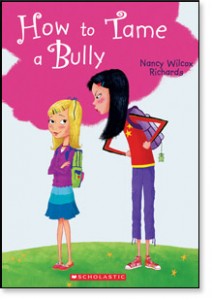
Lauren is excited to begin grade three. She is thrilled with her teacher and delighted to be in a class with her best friend. Lauren’s happiness dims quickly when she discovers that she is seated next to Bethany.
Bethany is a giant. She is almost as tall as Ms. MacArthur. And that’s when she’s sitting down… Her eyes are always moving. Watching everyone. I know what she is doing. She’s looking for her next victim. Someone she can force to do her homework. Someone she can beat up.
It is not long before Lauren and Bethany tangle. Bethany writes a message about Lauren on a washroom mirror and Lauren responds by giving Bethany a snack tainted with far too much salt and pepper. Bethany calls Lauren “Shrimp”, extorts recess snacks from her and splatters red paint on her new top.
When forced to work together on a school project, Lauren reachers her breaking point. She tells Bethany to stop calling her “Shrimp” and is surprised when Bethany agrees. They manage a temporary cease-fire while working together on their project but it is not until Lauren speaks up again that the relationship improves.
“Because you’re always bullying kids.”
Bethany stared back at me. Hard. Her eyes narrowed. But before she had a chance to say anything and before I ran out of courage, I continued. “You took some little grade one kid’s lunch money. You put gum on Rachael’s seat and she ruined her brand new pants. You threw a big rock through the gym window. And,” my voice started to get louder, “you keep taking my recess snack! That why you don’t have any friends. Bethany, you are just plain mean!”
Rather than resolving the bullying with an unrealistic “magical solution,” author Nancy Wilcox Richards has the girls work out a truce. Bethany’s bullying tactics subside and the girls learn to tolerate each other.
Last year, in our post titled Five Ways Young Children Can Say “No” to Bullying , we referred to Health Canada’s suggestion that one way to reduce bullying is to ask the bully to stop – a tactic that is used with success in How to Tame a Bully.
Suitable for readers in grades two or three, How to Tame a Bully is a 75 page, generously illustrated chapter book that encourages speaking up against bullying.
Guest contributor Jody looks at welcoming middle grade readers back to school in January.
I ended 2011 in the middle or near the end of too many projects. It’s always a dilemma to me; do I start fresh, trying to re-energize and engage the kids all over, or do I carry on from where we left off and show them the value and necessity in finishing what we start?
I did a little of both. When holidays started, I had only read 1/3 of a book called Lady in a Box, by Ann McGovern. It ties in so nicely to the holiday season, giving, and caring for others. It’s a great way to connect the kids to the outside world and to learn a number of powerful strategies in reading and writing. I was also reading Lemonade War, by Jacqueline Davies, as my read aloud. As well, the students were each in 1 of 5 reading groups, which were not going well. In addition to all of this, we were reading an assortment of Christmas picture books because the kids were creating their own children’s stories.
It’s difficult to walk away from some things, but on the other hand, if the students aren’t getting enough out of it, or if the teaching is not having the effect you thought it would, sometimes it’s better to cut and run. So, I fast-tracked Lady in A Box because the story is worthwhile and the message applies to life in general and not just a season. One down. I took the kids out of their reading groups because it was not going at all the way I planned and it was putting some of the kids off reading. Two down. I also gave up on Lemonade War because we have been talking about this book since September and many of the kids had read it. Three down. Then, I had to re-evaluate what it is I want and need the kids to know and decide how to help them get there. Eliminating the first two things was the first step.
The second step was to revitalize and re-energize the students. January is a new year, a fresh start, and in many ways, another September. We have to re-teach and review routines and expectations and we have to “hook” them again. I needed something that would immediately draw them in and help me re-work my book club as well. I found and started Inkheart by Cornelia Funke. I’m going to have to do a whole post dedicated just to Inkheart because it’s so good. For now though, I won’t go into too much detail about the novel. Just let me say that it has given my new year a definite push in the right direction.
The kids are are hooked on the novel (some have read it but are being awesome and not giving any information away). They’re settling into routine quicker because, in order to squeeze in a whole chapter each day, I have to start the read aloud right after recess. In addition to this, they’re already, in just four days, becoming more proficient at recognizing and asking lower level questions. What a great start to 2012 in the classroom!!
So, while I was sorry to put Lemonade War aside because I hate to leave things unfinished, I think it’s important to recognize when we need to do just that. Some things just don’t work the way you want them to. Part of learning and being successful, for us and for the students, is knowing when you need to step back and try another route. Sometimes giving up one thing in favor of spending your time and energy on something else is a better way to achieve your goal. For me, I gave up Lemonade War to allow for time to read Inkheart. I gave up my small book club groups to do whole group instruction, which is turning out way better.
So, whether it’s giving up on something, trading off, or trying a completely different approach, the important thing is to keep the end in mind. In the end, I want students to be engaged in what we are reading, to be thoughtful writers, and to know that when something just isn’t working, it’s okay to try a different tactic. We learn by doing. Sometimes what we learn, is that we have to start over. Happy New Year.
I really didn’t know quite what to expect when I picked up The Boy in the Dress. I guess you could say I was pretty much, ‘ready for anything.’ What I discovered was a thoughtful, poignant and humorous look at the life of a twelve year old boy who loves to play football (soccer) and whose best friend is a young Sikh. Dennis lives with his older brother and his heartbroken father. He misses his mum (mom) terribly and can’t seem to come to grips with the idea that she won’t be coming back to the family. Dennis enjoys sports and has many friends but he finds his day to day existence extremely ‘ordinary.’
After accidentally heading a ball through a school window and into the headmaster’s office, Dennis is told he must go to detention after school. When he arrives in detention, he discovers that he won’t be alone. Lisa, the most beautiful girl in the school, is also in the room. Dennis finds Lisa extremely attractive. He is delighted when they become friends and he has an opportunity to walk her home after school. Lisa and Dennis discover a mutual love of fashion and Vogue magazine which leads to Dennis attempting to disguise himself as a girl and assuming a rather extraordinary identity at school.
Superbly illustrated by Quentin Blake, The Boy in the Dress is very reminiscent of Roald Dahl’s wonderful books. It provides a humorous, thoughtful affirmation that, “You can be whoever you want to be.”
You may also be interested in our page titled “Diversity.” We highlight picture books and chapter books that celebrate and inform us about human diversity including learning disabilities, physical disabilities, allergies, single parent families, interracial families, same sex parents, aging, death and more.
Almost every time I make a Parent Ed presentation, someone asks for recommendations for the preteen crowd. Sometimes the request is very specific, “My daughter loves skating. Could you suggest a chapter book she might like?” Very often the request is for something, anything that a reluctant reader will enjoy. Lately, I’ve been kept busy by Ready Set, Learn presentations. I’ve not had much time for reading. When the calendar is full to the brim, I often turn to short chapter books, looking for a new gem that will appeal to young readers.
Here are some of the books I’ve been reading…
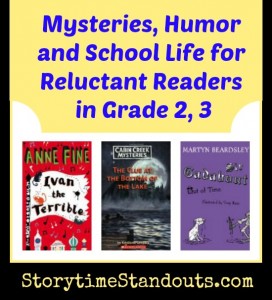
The Clue At The Bottom Of The Lake written by Kristiana Gregory Chapter book series for grade two/three readers published by Scholastic
Let’s begin with The Clue At The Bottom Of The Lake (Cabin Creek Mysteries). This is the second book in the new Cabin Creek Mysteries series. Appropriate for seven to ten year olds, it has a grade 3 Reading Level. I enjoyed the book and am confident that this is a series both boys and girls will enjoy. Set in a small, lakeside town, we follow three cousins as they investigate the dumping of a large and mysterious bundle into the lake near Lost Island. Young detectives will enjoy the twists and turns as Claire, David and Jeff work to discover the contents of the bundle and who is responsible for dumping it in ‘their’ lake.
Sir Gadabout Out of Time written by Martyn Beardsley Chapter book series for grade two/three readers published by Orion Children’s Books
Sir Gadabout is the ‘Worst Knight in the World.’ A creation of Martyn Beardsley, the series is illustrated by Tony Ross so we know that we are in for some fun. In Sir Gadabout Out of Time, disaster strikes when King Arthur allows Sir Gadabout to cut his hair. Before long, Merlin is enlisted to turn back time. Unfortunately (but not unexpectedly) the spell goes wrong and Sir Gadabout finds himself in a futuristic world with cell phones and cars. Good fun for nine to twelve year olds.
Ivan the Terrible written by Anne Fine Chapter book series for grade two/three readers published by Egmont Books Ltd
Poor Boris, he is in a real ‘pickle.’ He’s been asked to be a ‘chum’ and translate for a new classmate. They both speak Russian and Boris is asked to help the new boy adjust to life at St. Edmund’s, the civilized school. Before long, Boris realizes that Ivan is really quite nasty and the job of translating is going to be trickier than he had expected. A fine choice for nine to twelve year olds, Ivan the Terrible won the silver medal in the 2007 Nestlé Children’s Book awards.
ABC Canada Literacy Foundation has identified ‘three potential reading slump times that can hinder a child’s reading development. ‘ Grade four is one of those times. Grade four is just about the time that readers encounter longer chapters, smaller print and more complex vocabulary.
We lose some readers in the transition. My two boys are nine and twelve – one loves to read and one loves to “do” so I know that finding engaging books is critical for this age group. As well, I probably read more kids’ books than most moms so I’m often asked for book recommendations for middle grade boys. Many of the best series for this age group are funny (occasionally rude), action-packed, irreverent and some are very generously illustrated. The books often feature kids who find themselves in trouble – at school, at home, sometimes even in the library.
With nine, ten and eleven year old reluctant readers, we need to keep our goal in mind: get books (almost any books!) into their hands and encourage them to read.
Concurrently, in an ideal world, parents will continue to read aloud more challenging and diverse books – but that is for another day.
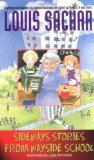
Sideways Stories from Wayside School – Written by Louis Sachar (author of Holes) I have had great success with this book. The wacky humor and very short chapters are very appealing to kids. Each chapter tells about one student at Wayside School – you don’t have to read them in order so kids can jump around the book if they wish.
Books in the Wayside School Series Sideways Stories From Wayside School Wayside School is Falling Down Wayside School Gets A Little Stranger
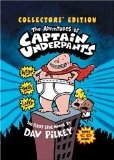
The Adventures of Captain Underpants– written by Dav Pilkey Have you ever met a boy who didn’t enjoy the ‘Action, Thrills, and Laffs of a Captain Underpants book? With rude humor and tons of illustrations, this series is great for even the most reluctant reader. Just don’t tell your kids that the series is mom approved – that would spoil the fun!
Books in the Captain Underpants Series silliness and rudeness are perfect for middle grade readers The Adventures of Captain Underpants Captain Underpants and the Attack of the Talking Toilets Captain Underpants and the Invasion of the Incredibly Naughty Cafeteria Ladies from Outer Space (and the Subsequent Assault of the Equally Evil Lunchroom Zombie Nerds) Captain Underpants and the Perilous Plot of Professor Poopypants Captain Underpants and the Wrath of the Wicked Wedgie Woman Captain Underpants and the Big, Bad Battle of the Bionic Booger Boy, Part 1: The Night of the Nasty Nostril Nuggets Captain Underpants and the Big, Bad Battle of the Bionic Booger Boy, Part 2: The Revenge of the Ridiculous Robo-Boogers Captain Underpants and the Preposterous Plight of the Purple Potty People Captain Underpants and the Terrifying Re-Turn of Tippy Tinkletrousers Captain Underpants and the Revolting Revenge of the Radioactive Robo-Boxers Captain Underpants and the Tyrannical Retaliation of the Turbo Toilet 2000
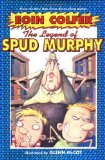
The Legend of Spud Murphy – written by Eoin Colfer (author of the Artemis Fowl series) When Will and Marty Woodman are told they must spend the summer in Spud Murphy’s Library, they know it will be a dangerous assignment. They’ve heard about the ‘gas-powered spud gun she keeps under her desk.’ Really good fun and a positive message about books and reading!
Books in the Legends of Series – popular with grade four boys Eoin Colfer’s Legend of Spud Murphy Eoin Colfer’s Legend of Captain Crow’s Teeth Eoin Colfer’s Legend of the Worst Boy in the World
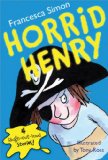
Horrid Henry’s Wicked Ways – written by Francesca Simon One of my nine year old’s favorites, Horrid Henry really is ‘awesomely wicked.’ It is the perfect antidote when you’ve had a rough day and you long to hear about someone who can relate to your troubles.
Books in the Horrid Henry Series – Horrid Henry Horrid Henry and the Secret Club Horrid Henry Tricks the Tooth Fairy Horrid Henry’s Nits Horrid Henry Gets Rich Quick Horrid Henry’s Haunted House Horrid Henry and the Mummy’s Curse Horrid Henry’s Revenge Horrid Henry and the Bogey Babysitter Horrid Henry’s Stinkbomb Horrid Henry’s Underpants Horrid Henry Meets the Queen Horrid Henry and the Mega-Mean Time Machine Horrid Henry and the Football Fiend Horrid Henry’s Christmas Cracker Horrid Henry and the Abominable Snowman Horrid Henry Robs the Bank Horrid Henry Wakes the Dead Horrid Henry Rocks Horrid Henry and the Zombie Vampire Horrid Henry’s Monster Movie Horrid Henry’s Nighmare Horrid Henry Krazy Ketchup
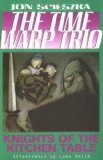
The Time Warp Trio by Jon Scieszka Featuring time travel, adventure, humor and a touch of fantasy, The Time Warp Trio is a great pick for middle grade readers. Sam, Fred and Joe use The Book to travel through time from one exciting adventure to another. I’ve had very good success drawing boys into this series. There is something for everyone: pirates, knights, neanderthals and Egyptians.
Books in the Time Warp Trio Series – Knights of the Kitchen Table The Not-So-Jolly Roger The Good, the Bad, and the Goofy Your Mother Was a Neanderthal 2095 Tut Tut Summer Reading Is Killing Me It’s All Greek to Me See You Later Gladiator Sam Samurai Hey Kid, Want to Buy a Bridge? Viking It and Liking It Me Oh Maya Da Wild, Da Crazy, Da Vinci Oh Say, I Can’t See Marco? Polo!
One of my favourite parts of the school year is the first few weeks. I love mapping things out and getting to know my students. I love choosing my first read aloud and getting them hooked. In the past I have done Tuck Everlasting (I just love this story), Zebra Wall, and Sixth Grade Secrets (one of the funniest books). This year I have decided, thanks to a great workshop I attended, to try something different.
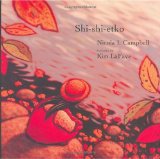
I generally start with a novel as a way of introducing reading strategies, such as predicting, questioning, and summarizing. However, instead of a novel, I am going to start with a book called, Shi-shi-etko by Nicola I. Campbell and illustrated by Kim LaFave. It is actually a picture book recommended for ages 4-7. I am teaching grade 4/5 this year but I think that in addition to being able to introduce reading strategies, this story will allow me to establish a stronger sense of community right from the start.
Shi-shi-etko tells about a child’s experience with residential schools. It’s heartbreaking and beautiful. It will give me the opportunity to introduce themes of community, diversity, anxiety, family, and inclusion. These are all topics that need to be present in any classroom, but more so in a split grade classroom I think. In general, split classes are viewed negatively. Parents don’t want their child working below or beyond their capabilities and kids who have waited to experience certain things offered to their grade (like field trips) resent having to share these adventures. These thoughts seem at odds with the growing awareness of the need for differentiation in the classroom. Split grade or straight, more than one level of need is being met in all classrooms. It is important for teachers to find a way to motivate all learners and to do this, a community of acceptance needs to be established as quickly as possible. A classroom that students feel accepted, trusted, and safe in will promote positive learning experiences.
When my students come to my class this year, I want them to worry less about whether or not the work is really grade four work or grade five work. I want them to focus on contributing to a positive community atmosphere. I want them to feel safe to explore what kind of learning best suits them. I want them to accept the ideas, feelings, and beliefs of others and have this reciprocated. While I have grade level curriculum to teach, my hope is that we will go beyond that. I want them to be able to achieve academic success, but more importantly, I want them to acquire the tools that will help them become lifelong learners that accept and appreciate the unique backgrounds of others. I hope that in addition to powerful reading strategies, Shi-shi-etko will pave the way to a safe, strong sense of community in our class, built on trust, tolerance, and acceptance.
We have all sorts of goodies lined up for September but thought we would give you a taste today. Our Fall printables include interlined paper (Back to School and Fall themes), a special alphabet, “school” vocabulary and some “Squirrel” goodies.
We are currently pulling together our favourite picture books for autumn – colourful leaves, and crisp, cool days are not far away.
Our early literacy printables, including our Fall printables are in PDF format, if you don’t already used Adobe Reader, you will need to use it to access the downloads.
Please note: some of our early literacy printables are available to Storytime Standouts members only. To become a member of the website (without cost or obligation), please click on the “Members” tab and register as a user.
If you appreciate our free early literacy printables,
including these Fall-theme early learning materials,
please support this site by visiting and purchasing from Amazon.com or Amazon.ca.
Enjoy these Fall printables and be sure to let your friends and colleagues know about Storytime Standouts.
A Fall Leaves Alphabet
Attractive free alphabet printable features multi coloured Fall leaves
School Picture Dictionary
Free printable school picture dictionary for readers and writers in kindergarten and grade one. Also a great resource for ELL / ESL
It’s safe to say that reading a book that you can relate to provides a more enjoyable read. Add humour, sibling rivalry, sibling loyalty, and a little competition just makes it better. In The Lemonade War, Jacqueline Davies has created a book that not only encompasses all of these elements, but speaks to a variety of age groups. While her story details the ‘battle of the stands’ between brother and sister, Davies weaves in the topics of friendship, determination, ambition, and forgiveness. She does so through realistic characters, funny dialogue, and a number of interesting situations that the kids find themselves in as a result of their war.
Evan Treski loves and even likes his little sister…most of the time. Jessie Treski idolizes her big brother. While she is smart enough to skip a grade and go into grade four, the same grade her brother is going into, she knows that she’s not the best ‘people person’. That’s Evan’s gift; hers is math. When the two find out they will not only be in the same grade, but the same class, Jessie thinks this will just make things easier for them. She’ll help Evan with math and he’ll help her with friends. Evan feels differently. He’s mortified. How can he possibly go into the same class with his baby sister? How can he keep his friends if they find out how dumb he is compared to her? Rather than telling each other how they feel, they embark, in typical sibling fashion, on an entrepreneurial war. They will see what matters more; people skills and flexibility or strategic plans and organization. One of them will win The Lemonade War, but both of them are willing to do almost anything to come out ahead.
As a teacher, I thought this was a fun, light, close-to-summer read. Though it’s not new, I hadn’t heard of it and I didn’t expect to enjoy it nearly as much as I did. Once I read it to my grade five class, who enjoyed and connected with the sibling rivalry, I brought it home to read to my 8 year old daughter. Re-reading it, this time as a mom, I was able to connect to it on a new level. My 8 year old reminds me of Jessie with her thorough plans and detailed organization. My 5 year old daughter reminds me of Evan, with his charm and easy social skills. It was easy to imagine the two of them participating in a Lemonade War of their own. Jacqueline Davies realistically portrays the feelings of her main characters, making you connect with both Evan and Jessie. That connection has you turning the pages, unsure of who you want to come out the winner!
Pink – written by Nan Gregory and illustrated by Luc Melanson
We’ve all seen them, “The Pinks,” Vivi calls them, but not out loud. Every day at school they parade their glory – from hair bows to tippy toes, every shade of perfect pink.”
Poor Vivi would love to be just like “The Pinks.” Her rather ordinary world is not at all pink. She lives, with her blue collar parents and her baby brother, in a brown working class world that leaves her yearning. Her parents are not unaware of her desire to be a “Pink,” they have had their share of disappointments but they have found ways to accept and live within their means.
One day, when Vivi is running an errand for her mom, she discovers the ultimate pink treasure. She sees a beautiful doll, dressed in a cascading pink bridal gown. It is displayed prominently in the window of an exclusive neighbourhood shop. Vivi feels she must have it so she does chores and small jobs all winter to earn money. She saves and saves in order to buy the beautiful doll. She is certain that having the spectacular doll will enable her to live like the wealthy “Pink” girls she sees at school.
Pink is a marvelous story that is both poignant and thoughtful. Vivi wants so much to be a “Pink” and her young heart is filled to bursting with desire for the doll. When Vivi witnesses one of the “Pinks” leaving the store with “her” doll, she is heartbroken but ultimately enriched by the experience.
It would have been so easy to create a magical happy ending and have Vivi’s world become a pink one. Thankfully, Ms. Gregory understands that life is not always fair and that if we take time to look, beauty (and especially pink) is all around us. When sharing this thoughtful story with a child, be sure to take note of Mr. Melanson’s illustrations and especially his masterful depictions of Vivi’s emotions.
Very highly recommended, for children four and up.
Desmond is the sort who likes to remain inconspicuous. Rather than stand out, he likes to blend in and he takes care to hide his true personality. “Then one day someone new came to school. Her name was Gloria and she liked to be noticed. ” Gloria is not at all like her classmates, she notices Desmond even when he is doing his very best to disappear. When Gloria notices that Desmond shares her taste in books, she asks if she can read with him. Gloria and Desmond companionably share the book and Desmond is transformed. The following day Desmond and Gloria play together, each respecting the other. Before long Desmond feels and looks different – he wonders why he ever wanted to disappear.
Disappearing Desmond has a lovely message about finding new friends and respecting differences. Cheerful, acrylic illustrations will have strong appeal for young readers as they search for Desmond. Very observant readers will notice and appreciate the two posters on the library wall.
Marty is not yet impressed with grade three. Her former best friend has a new friend who likes dancing. Marty would rather catch frogs than waltz. She misses her friend very much. “Veronica Grace Smithers has stolen my best friend and taken over recess. I’d call Veronica Grace Princess Bossy-Pants if I were allowed to call people names. But I’m not. So I won’t.”
When their teacher announces that the class will be performing The Frog Prince and Marty will be cast as the princess, our young heroine is reluctant to take the stage. Portraying a princess is not for her! Marty McGuire accurately depicts the social challenges experienced by a group of grade three girls as they adapt to change. As well, Marty and her friends manage to find middle ground in this fun, generously illustrated chapter book.
Will be enjoyed by boys and girls, grade two and up.
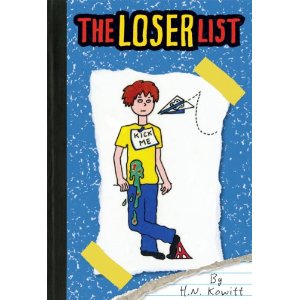
The Loser List – written and illustrated by Holly N. Kowitt Anti bullying (handwritten text, generously illustrated) chapter book published by Scholastic
I spent the Easter weekend with three teenaged boys and so it was only fitting that I should reach for The Loser List when I had some time to read. It is a generously illustrated chapter book that is very reminiscent of Diary of a Wimpy Kid
Danny Shine is twelve years old and in grade seven. He’s not good at sports but he loves to draw. When Danny runs afoul of Chantal Davis, she informs him that she’ll be adding his name to the loser list in the girl’s bathroom at school. Danny’s best friend, Jasper is not worried about being labelled as a geek and doesn’t care if his name is put on the loser list but Danny is bothered by the threat. A lunchtime tangle with the school’s biggest bully (Axl Ryan) followed by a failed attempt to remove his name from the loser list results in Danny joining Axl and other members of the Skull gang in an after school detention. “We stared at each other. Him: studded wristband, greasy blond hair stuffed into a do-rag, and army jacket. Me: Acme Exterminators tee, video watch and grandfather sweater.” Danny is terrified of Axl and is sure he will be beaten until Axl shows off his Sharpie tattoo and Danny knows that he can draw “Something really cool and unique, something that’s you know, worthy of the Skulls.”
It is not long until the threat of a beating subsides and Danny is creating cool tattoos for Axl and his sidekicks. Danny enjoys his new celebrity until Axl steals a comic book from a shop Danny frequents. Suddenly Danny finds himself accused of theft and regretting his association with the thugs.
A clever tactic by Danny and Jasper enables Danny to escape the clutches of the gang and restore his reputation.
Best for children aged eight through twelve, The Loser List has a positive message about self acceptance and friendship. It will have a special appeal for boys
Meet Nancy Carlson, author and illustrator of Henry and the Bully
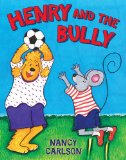
Henry and the Bully written by Nancy Carlson A picture book about bullying in the schoolyard
Henry is in grade one and loves to play soccer during recess break. Unfortunately, Sam, who is older and considerably bigger spoils the game by teasing and stealing the soccer ball. In Henry and the Bully, Henry seeks help from Mr. McCarthy but his teacher is busy with other playground problems and does not help the grade one children. Soon, Henry feels terrible and thinks he is too sick to go to school.
A chance meeting at a department store provides Henry with an opportunity to surprise the bully and recruit a new soccer player.
Read the entire story online and give a book to a child who doesn’t have one by visiting We Give Books
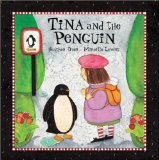
Tina and the Penguin – Written by Heather Dyer and illustrated by Mireille Levert
Picture book published by Kids Can Press
A thoroughly delightful picture book about a young girl and her very special penguin friend!
When Tina’s class from school visits the zoo, she finds herself helping a homesick penguin to escape an enclosure. Tina disguises her new feathered friend and they board the school bus together. When she takes the penguin home, Tina discovers that caring for her rather unusual houseguest is no simple matter. Mom wonders about the fishy smell and the feathers floating through the air in Tina’s bedroom and, wanting to ensure her new friend’s comfort, Tina discovers that sharing an ice water bath and sleeping with the window open is tough to take.
Distinctive, eye-catching and colourful illustrations make Tina and the Penguin a great book to share with a group.
Recommended for children aged 5 to 8, Tina and the Penguin would be a nice addition to a classroom zoo or penguin theme. The story also lends itself to making predictions.
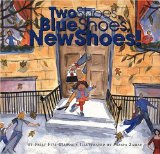
Two Shoes, Blue Shoes, New Shoes! -Written by Sally Fitz-Gibbon, Illustrated by Farida Zaman Picture book published by Fitzhenry and Whiteside
Wearing new blue shoes to school, our happy heroine bounces through city streets with great enthusiasm. Delightful watercolor illustrations exude energy and compliment the simple, rhyming text beautifully.
Swinging from a rope, shoes,
With an antelope, shoes!
Riding on a whale shoes,
See him splash his tail, shoes!
This week the American Library Association announced the top books, video and audiobooks for children and young adults – including the Caldecott, Coretta Scott King, Newbery and Printz awards for 2011.
Following on my posts earlier this week of some award winners, the Schneider Family Book Awards and the Pura Belpré Awards for 2011 are as follows:
Schneider Family Book Award for books that embody an artistic expression of the disability experience
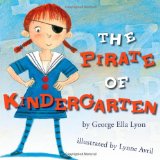
The Pirate of Kindergarten, written by George Ella Lyon, illustrated by Lynne Avril and published by Atheneum Books for Young Readers, an imprint of Simon & Schuster Children’s Publishing Division, wins the award for children aged 0 to 10.
After Ever After, written by Jordan Sonnenblick and published by Scholastic Press, an imprint of Scholastic Inc., is the winner of the award for middle-school readers (aged 11-13).
Three Belpré Author Honor Books were named: ¡Olé! Flamenco, written and illustrated by George Ancona and published by Lee & Low Books Inc.; The Firefly Letters: A Suffragette’s Journey to Cuba, written by Margarita Engle and published by Henry Holt and Company, LLC; and 90 Miles to Havana, written by Enrique Flores-Galbis and published by Roaring Brook Press, a division of Holtzbrinck Publishing.
Pura Belpré Award honoring a Latino illustrator whose children’s books best portray, affirm and celebrate the Latino cultural experience
Grandma’s Gift, illustrated and written by Eric Velasquez, is the 2011 Belpré Illustrator Award winner. The book is published by Walker Publishing Company, Inc., a division of Bloomsbury Publishing, Inc.
Three Belpré Illustrator Honor Books for illustration were selected: Fiesta Babies, illustrated by Amy Córdova, written by Carmen Tafolla and published by Tricycle Press, an imprint of the Crown Publishing Group, a division of Random House, Inc.; Me, Frida, illustrated by David Diaz, written by Amy Novesky and published by Abrams Books for Young Readers, an imprint of ABRAMS; Dear Primo: A Letter to My Cousin, illustrated and written by Duncan Tonatiuh and published by Abrams Books for Young Readers, an imprint of ABRAMS.
Having finished reading The Alchemist’s Dream, I decided to take a look at some chapter books for younger readers. this week I read three books and enjoyed them all. Let’s begin with…
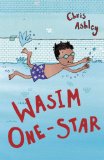
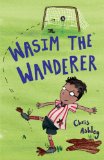
Wasim One-Star written by Chris Ashley, illustrated by Kate Pankhurst Chapter book for primary to middle grade readers published by Frances Lincoln Children’s Books
Wasim can hardly wait to pass a school swimming test and become a One-Star swimmer. Unfortunately, on the day of the test, Wasim finds himself in trouble. His concern for a new classmate whose English is not good causes him to speak more loudly than he should. Wasim is heartbroken when he is sent (untested) to the pool changing room because of his loud voice.
Wasim’s concern that Wayne’s poor English could cause him to get into difficulty is justified. Fortunately, Wasim is watching and responds quickly when Wayne gets in over his head.
Wasim is a great character – in fact, I’d call him a ‘rising star.’ His desire to pass the swimming test and his concern for a classmate are both genuine and admirable. I particularly liked the dynamics between the students, the swim instructor and the teachers. Recommended for boys and girls, aged 6 and up.
As an Amazon Associate I earn from qualifying purchases.
Links to our Free Printables
Links to Seasonal Themes
Links to Special Themes
Links to Our Favorite Series
Disclosure –
We NEVER get paid to review products on this site.
In some cases, I receive books to review free of charge. In other cases I review books that I have purchased or have borrowed from a public library. Whether I receive a book free of charge or not does not influence my review.
If you have questions or concerns about our policies, please do not hesitate to email for details.


 Jake Drake Bully Buster written by Andrew Clements










 . This is the second book in the new Cabin Creek Mysteries series. Appropriate for seven to ten year olds, it has a grade 3 Reading Level. I enjoyed the book and am confident that this is a series both boys and girls will enjoy. Set in a small, lakeside town, we follow three cousins as they investigate the dumping of a large and mysterious bundle into the lake near Lost Island. Young detectives will enjoy the twists and turns as Claire, David and Jeff work to discover the contents of the bundle and who is responsible for dumping it in ‘their’ lake.




 won the silver medal in the 2007 Nestlé Children’s Book awards.

















 or







 is a marvelous story that is both poignant and thoughtful. Vivi wants so much to be a “Pink” and her young heart is filled to bursting with desire for the doll. When Vivi witnesses one of the “Pinks” leaving the store with “her” doll, she is heartbroken but ultimately enriched by the experience.

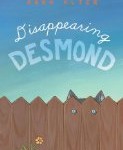

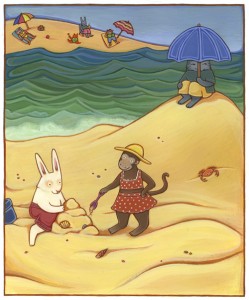
 has a lovely message about finding new friends and respecting differences. Cheerful, acrylic illustrations will have strong appeal for young readers as they search for Desmond. Very observant readers will notice and appreciate the two posters on the library wall.

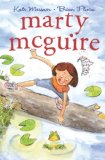
 accurately depicts the social challenges experienced by a group of grade three girls as they adapt to change. As well, Marty and her friends manage to find middle ground in this fun, generously illustrated chapter book.


 when I had some time to read. It is a generously illustrated chapter book that is very reminiscent of


 , Henry seeks help from Mr. McCarthy but his teacher is busy with other playground problems and does not help the grade one children. Soon, Henry feels terrible and thinks he is too sick to go to school.

 a great book to share with a group.