Journey is Wondrous, beautiful, inspiring, magical
–
So many words could accurately describe this books for children. A wordless picture book, Journey is the story of a city-dwelling girl whose family members are occupied with chores and technology. As she sits, bored and perhaps lonely, on the front stoop, a neighboorhood boy stands nearby, holding a purple crayon. She goes inside the house and tries to engage her family members in play but they are busy. Disappointed, she goes to her bedroom. Moments later, she notices a red crayon on the bedroom floor. She picks it up, draws a doorway on her bedroom wall and escapes her boring, sepia-toned environment. Soon she is surrounded by gorgeous, glowing colors. Her magical red crayon allows her to create a rowboat, a hot air balloon and a magic carpet as she explores a mystical word, filled with unusual people, intriguing buildings and fascinating machines.
In this wondrous world, she encounters the neighboorhood boy with the purple crayon, the circle is completed and she discovers a new friend.
Highly recommended, this book will be appreciated most by children aged four years and up. As well, adults will be inspired by both the illustrations and the narrative.
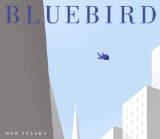
A small bluebird flies through a city, past an apartment building and toward a school. The bird perches in a tree and watches as a young boy approaches the school. Unlike the other students, he walks alone with his eyes turned downward. Whereas other children chatter happily with their friends, he is slow to walk into his new classroom and take his place. Once he is seated, two classmates laugh and point. For some reason, he is a lonely outcast and the object of ridicule.
The hours tick by and, when the boy leaves school, he is surprised when the friendly bluebird initiates a friendship. The bird chirps at him and follows him through an urban neighborhood. They play hide and seek, they share a cookie, they watch as a group of children play soccer and they arrive at a park where the boy floats a sailboat in a pond. There is time for happy daydreaming and exploring before their adventure takes an ominous turn. The boy and the bird approach a wooded area and are soon met by three miserable bullies. One wants his toy sailboat and, to add force to his threats, he throws a stick, hitting the swooping bluebird. As the violent bullies run from the scene, the bereft boy stands, holding the injured bird.
Highlighted by light blue, grey and white Adobe Photoshop-rendered illustrations, Bluebird is best suited to children aged five and up. With an ending that is open to interpretation, the author-illustrator leaves many questions unanswered. The boy is very much a solitary figure, we don’t know why he is on his own in a large city. We also don’t know why he is ridiculed by his classmates and bullied by the children in the park. This is not a story that satisfactorily resolves bullying rather it is a celebration of friendship. Young readers will have questions and opinions. They will engage in the narrative and, with encouragement, will think about the impact of bullying behavior.
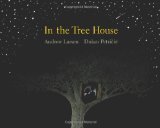
In the Tree House written by Andrew Larsen and illustrated by Dušan Petričić Picture Book published by Kids Can Press
One of my favorite parenting memories involves snuggling with my sons and watching the Perseid Meteor Showers. When they were young, we scheduled an annual camping trip with friends so that we would be away from city lights and able to watch for shooting stars. I will never forget the experience of sitting beachside in a folding chair with one of my sons on my lap. We would wrap a blanket around us and wait. Most years there were eight of us searching for the dramatic streaks of light across the night sky. Each time a meteor appeared, there would be squeals of delight, “Oh, did you see THAT one?”
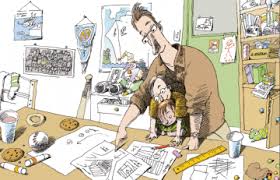
Andrew Larsen’s In the Tree House tells of a young boy who is feeling the changes that time brings. He and his family move into a new house and, instead of sharing with an older brother, he has his own room. He misses having his brother in his room and he has trouble falling asleep. He uses his wakefulness to plan treehouses. He’s excited when his brother starts drawing treehouses and he’s thrilled when his dad agrees to make his dream a reality. It is not long before Dad and sons are perched up high, gazing at the night sky.
“Why arent there any stars?” I asked between gulps of lemonade.
“They’re up there,” Dad said. “We just can’t see them,”
He explained how the lights from the city make the sky too bright for us to see the stars shine.
They boys love spending their summer in the tree house. They play cards and read comics and watch their neighborhood.
The following year, circumstances have changed. The older brother has new friends and they keep him busy. The tree house that was once magical now seems empty until a chance power outage transforms the neighborhood. In the darkness, the older brother returns to the tree house and the boys’ special relationship is revealed once again – just as the utter darkness reveals a sparkling night sky.
In the Tree House is a shining tribute to the special relationship between siblings and the small, meaningful moments that make a world of difference.
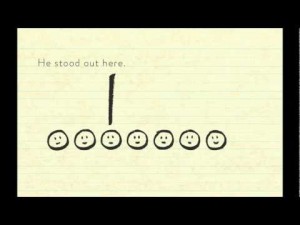
Exclamation Mark is just not like anyone else. As much as he’d like to look the same, he’s always a standout in a crowd.
He was confused, flummoxed, and deflated.
He even thought about running away..
Clever wordplay and fun, expressive illustrations will captivate children old enough to understand punctuation and the important role it plays in our language. Older readers will enjoy the double entendre and will celebrate Exclamation Mark’s voyage of self discovery.
Why oh why is he different? He wants nothing more than to look just like the periods around him. It is only when Question Mark arrives on the scene that Exclamation Mark discovers something deep within – he discovers why and how he has an important role to play – despite his rather unique upright appearance.
An outstanding 2013 picture book, Exclamation Mark is highly recommended for readers aged five years and up.
“Play is the work of the child.” – Maria Montessori
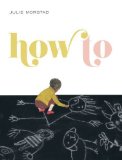
There are shelves filled with how to books at my local library. How to change the oil in a car, how to sew a quilt, how to apply make up… These are all jobs for adults. When writing and illustrating a how to book for children, what should be the topic? What is there that children ought to do?
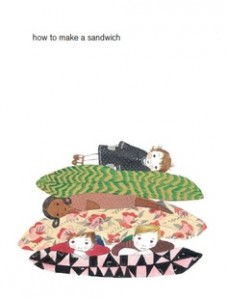
Julie Morstad’s How To is a celebration of play and self discovery. When a child wants to go fast, he might choose a scooter or a pair of stilts. When another child decides to go slow she may quietly lie in a grassy spot and enjoy the flowers and butterflies.
Beautifully drawn illustrations celebrate a diverse group of children at play – flying kites, drawing with sidewalk chalk, hiding, riding a bicycle, drumming on pots and pans and contemplating a steep, high slide. Minimal text and mostly white pages ‘leave space’ for thinking, appreciating the illustrations and imagining ways to enjoy more play.
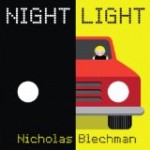
Night Light written and illustrated by Nicholas Blechman Picture book with die cuts published by Orchard Books an imprint of Scholastic
When my sons were young, they loved picture books about vehicles. Whether reading Richard Scarry’s Cars and Trucks and Things That Go or Diane Siebert and Byron Barton’s Truck Song, my boys loved stories about emergency vehicles, trains, construction trucks and farm equipment. We would admire the interesting vehicles we saw while out on the road and check them out more closely when they were parked. On more than one occasion, I recall walking around big rigs – cement trucks and fire engines were especially appealing.
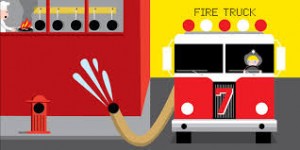
Night Light is a picture book my boys would have loved! Bright, colorful computer-generated illustrations include a zooming train, a hovering helicopter, a shiny taxi, a chugging tugboat, a hard-working loader and a gleaming firetruck. All have lights that shine in the dark. Youngsters will enjoy counting the lights, hearing clues and then speculating on what vehicle’s lights are glowing through the die cuts. As well, they will enjoy looking at the flip side of the die cuts and how Blechman incorporates the black circles they create into the left side of each spread.
Do you know which vehicle has three lights shining late at night or what sort visits many sites?
Whether enjoyed as a counting book or as a part of a transportation theme, Night Lights is best-suited to preschool or kindergarten age children. It could also be used as inspiration for older children, prompting an exploration of art techniques that incorporate the magic of die cuts.
Some reviewers have commented about the final illustration of the book. It is printed on the end papers and, when the book jacket is in place, it is partially obscured. Similarly, at the front of the book, the book jacket covers the publishing details enhancing the look of the first pages. While perhaps not ideal, this does not detract from the appeal this story will have for transportation enthusiasts.
As an Amazon Associate I earn from qualifying purchases.
Links to our Free Printables
Links to Seasonal Themes
Links to Special Themes
Links to Our Favorite Series
Disclosure –
We NEVER get paid to review products on this site.
In some cases, I receive books to review free of charge. In other cases I review books that I have purchased or have borrowed from a public library. Whether I receive a book free of charge or not does not influence my review.
If you have questions or concerns about our policies, please do not hesitate to email for details.


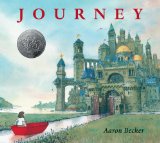 Journey created by Aaron Becker